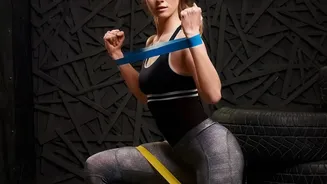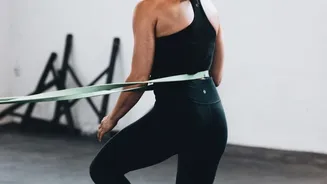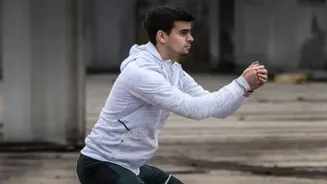




1. Banded Plié Squat
This exercise takes a foundational ballet movement and adds a strength-training component. The plié squat is excellent for targeting the inner thighs, glutes, and quadriceps, while the dance-inspired form promotes better posture and hip rotation. Adding
a resistance band enhances muscle activation, particularly in the gluteus medius, a key stabilizer for your hips. How to do it: Place a looped resistance band just above your knees. Stand with your feet wider than your shoulders and turn your toes out to a comfortable angle, like a ballet dancer in second position. Keeping your torso upright and core engaged, lower yourself into a squat, pressing your knees outward against the band. Go as low as you can while maintaining a straight back, then press through your heels to return to the starting position. Focus on slow, controlled movement.
2. Standing Arabesque with Band
The arabesque is an iconic, elegant ballet pose that powerfully challenges your balance, core stability, and posterior chain. By using your own bodyweight for stability and adding a band for resistance, you create a dynamic exercise for the glutes and hamstrings. This move improves proprioception—your body's awareness of its position in space. How to do it: Loop a resistance band around both ankles. Stand tall and shift your weight onto your left leg, keeping a micro-bend in the knee. Engage your core and slowly extend your right leg straight back behind you, leading with your heel. As you lift your leg against the band's tension, keep your hips square to the front. Your torso will naturally hinge forward. Lift your leg as high as you can without arching your back, hold for a moment, and then slowly lower it back down. Complete your reps on one side before switching to the other.
3. Curtsy Lunge with Banded Row
The curtsy lunge adds a rotational, dance-like flair to the traditional lunge, targeting the inner and outer thighs as well as the glutes. By incorporating a banded row, you transform it into a full-body exercise, engaging your back and biceps simultaneously. This compound movement is highly efficient, improving coordination and strength. How to do it: Secure a long resistance band to a stable anchor point, like a doorknob, at waist height. Hold the other end of the band with both hands. Step back with your right leg, crossing it behind your left leg as if you were doing a curtsy. As you lower into the lunge, simultaneously pull the band towards your chest, squeezing your shoulder blades together. Your arms will perform a rowing motion. As you step your right leg forward to return to the start, release the tension in the band. Alternate legs with each repetition.
4. Glute Bridge with Banded Abduction
This exercise is a staple in both Pilates and physical therapy for its ability to isolate and strengthen the glutes and hamstrings. The dance influence comes from the focus on precise, controlled hip movement. A glute bridge is a pure bodyweight move, and adding a band for abduction (pushing the knees apart) fires up the outer glute muscles for enhanced hip stability. How to do it: Lie on your back with your knees bent and feet flat on the floor, hip-width apart. Place a looped resistance band just above your knees. Engage your core and lift your hips off the floor until your body forms a straight line from your shoulders to your knees. At the top of the bridge, pulse your knees outward against the band two or three times. Ensure your hips don't drop during the pulses. Lower your hips back down to the starting position with control and repeat.
5. Pilates Roll-Up with Band
The roll-up is a classic Pilates and dance warm-up exercise that focuses on spinal articulation and core strength. It promotes flexibility in the spine and a deep abdominal connection. Using a resistance band can assist with the movement, making it more accessible for beginners while still providing a challenge. How to do it: Sit on the floor with your legs extended straight out in front of you. Loop the middle of a long resistance band around your feet, holding one end in each hand. Start by slowly rolling down onto your back, one vertebra at a time, using your core to control the descent. Once you are lying flat, inhale. On the exhale, use the band for light assistance as you peel your head and shoulders off the floor, rolling back up to the seated starting position. The goal is fluid, continuous motion, not momentum.