






A Delivery Service for the Moon
Before astronauts can live and work on the Moon for extended periods, NASA needs to send a lot of supplies, science experiments, and scouting equipment ahead of them. This is where the Commercial Lunar Payload Services (CLPS) initiative comes in. Established
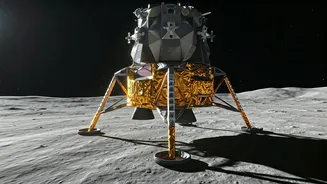
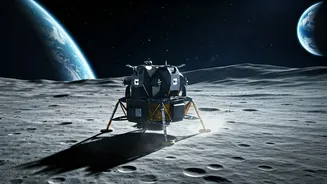
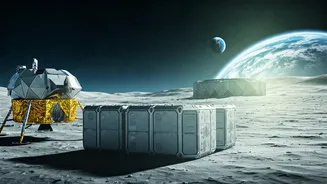
in 2018, this program essentially hires private American companies to build and fly robotic landers to the Moon, acting as a celestial delivery service. With a budget of $2.6 billion through 2028, NASA purchases space on these landers to send its payloads, rather than building and owning the spacecraft itself. This approach is designed to foster a commercial lunar economy, increase the frequency of missions, and accelerate the development of technologies needed for a sustainable human presence. Companies like Astrobotic, Intuitive Machines, and Firefly Aerospace are among the key players, with several missions already completed and many more scheduled.
More Than Just Dust Collectors
The cargo these missions carry is crucial for planning the Artemis Base Camp. The payloads are a mix of scientific instruments and technology demonstrations. For example, drills like the Regolith and Ice Drill for Exploring New Terrain (TRIDENT) are being sent to dig nearly a meter below the surface to search for water ice. Spectrometers are designed to analyze the lunar soil and any gases released, confirming the presence and concentration of resources. Finding accessible water ice is a top priority, as it can be converted into breathable air, drinking water, and even rocket propellant, which dramatically reduces the amount of material that needs to be launched from Earth. Other instruments measure the harsh radiation environment to understand how to protect future astronauts, while cameras study how rocket exhaust interacts with the lunar surface to ensure safer landings for larger, crewed vehicles.
Scouting the Perfect Location
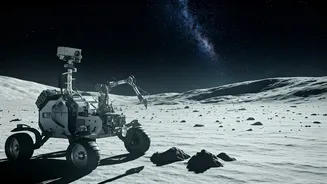
A major goal of the CLPS missions is to scout and characterize potential sites for the future Artemis Base Camp, which is envisioned for the Moon's South Pole. This region is believed to hold significant deposits of water ice in its permanently shadowed craters. Robotic landers and rovers sent through CLPS act as advance scouts, creating 3D maps of polar regions, analyzing the soil, and identifying the most resource-rich and geologically stable areas. These missions provide the essential ground-truth data that remote observations from orbit cannot. By landing in different areas, like the recent missions to the Gruithuisen Domes and the lunar far side, scientists can build a comprehensive understanding of the Moon's geology and resource distribution, helping NASA make the most informed decision on where to build humanity's first off-world outpost.
Building a Base, Bit by Bit
The Artemis Base Camp won't appear overnight. The concept involves a foundational surface habitat, a lunar terrain vehicle for transport, and a habitable mobility platform for longer-range exploration. The CLPS missions are the first step in testing the very technologies needed to make this a reality. They demonstrate precision landing, power generation, and the ability to survive the extreme temperatures of the lunar day and night. Future CLPS missions are slated to deliver larger and more complex hardware, including pieces of infrastructure, power systems, and advanced rovers. Just recently, on June 30, 2026, NASA announced four new CLPS missions to fly by 2028, specifically to support the development of a permanent base. This steady cadence of robotic deliveries is methodically putting the pieces in place, from power sources to navigation aids, that will eventually be used by Artemis astronauts.