




The Universe's Heavyweight Problem
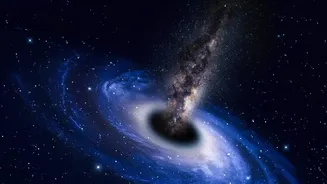
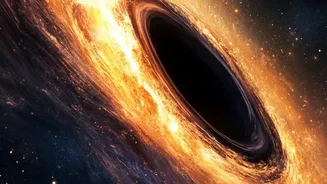
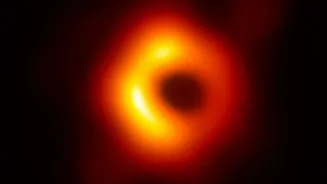
In the grand cosmic story, the timeline for supermassive black holes feels all wrong. These gravitational behemoths, which anchor the centers of most large galaxies like our own Milky Way, have been spotted by telescopes like the James Webb Space Telescope
(JWST) in the universe's infancy, less than a billion years after the Big Bang. The problem is, our classic understanding of how black holes grow doesn't add up. The standard model involves a black hole steadily pulling in gas and dust, or merging with other black holes. But these processes are thought to be too slow to create such monsters in the limited time available. It's like finding a fully grown redwood tree in a forest that was only planted last year. Astronomers have long theorized that there must be a way for them to grow much faster, but the evidence has been elusive.
Hiding in Plain Sight
The latest clue in this cosmic mystery came from an object that was so bright, it was initially mistaken for a nearby star. Known as J0529-4351, this object is a quasar—an intensely luminous galactic core powered by a feeding supermassive black hole. Its light has traveled for over 12 billion years to reach us, giving us a snapshot of the universe when it was a mere toddler. After being flagged in data from the 1980s and then misidentified by automated systems, astronomers in Australia and Chile finally confirmed its true nature. It turned out to be the most luminous object ever observed, shining with the light of 500 trillion suns. This incredible brightness is powered by the fastest-growing black hole yet found, one that devours the equivalent of one sun every single day.
Pushing the Theoretical Limit
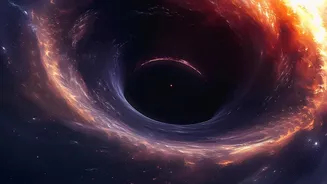
The immense appetite of J0529-4351 is what makes it a 'cosmic puzzle' and a potential Rosetta Stone for early black hole growth. Black holes can't just eat infinitely fast. There's a theoretical speed limit, known as the Eddington limit, where the outward pressure from the radiation of the super-hot material falling in balances the inward pull of gravity. Try to feed it faster, and the radiation should blow the excess material away. However, J0529-4351 is accreting matter right at this theoretical maximum. Other recent discoveries have even found black holes that appear to be growing at rates far exceeding this limit, a phenomenon called super-Eddington accretion. These rule-breaking objects suggest that under the right conditions in the chaotic early universe, black holes could have gone through short, incredibly rapid growth spurts.
A New Kind of 'Black Hole Star'?
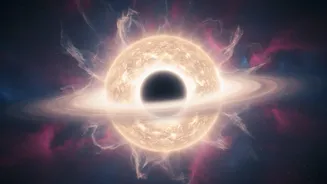
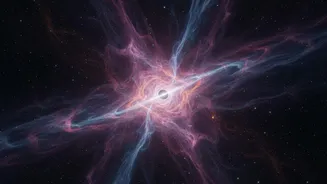
Related research from MIT astronomers, also using the JWST, has recently uncovered another piece of the puzzle. They identified a mysterious, bright red object from the cosmic dawn that they've dubbed a 'black hole star'. This object, MoM-BH*-1, appears to be a nascent black hole with a mass of around 100,000 suns, but instead of a typical, flat accretion disk, it's shrouded in a huge, dense envelope of gas that resembles a star. This unique structure could allow a black hole to grow much more rapidly, shielded from the outward radiation pressure that would normally slow it down. It provides a potential physical model for how the 'seeds' of supermassive black holes could have bulked up so efficiently. This discovery suggests a new phase of black hole evolution, one that might be common in the early universe but never directly seen before.