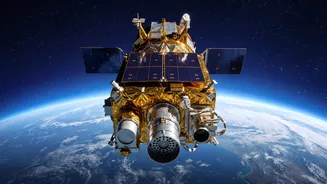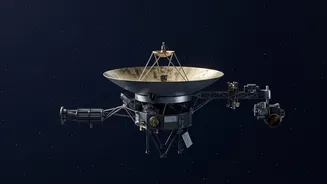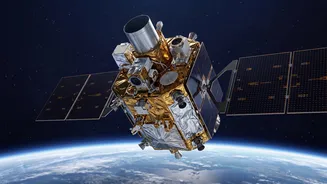



After nearly 22 years of chasing cosmic explosions, NASA's Neil Gehrels Swift Observatory took its final bow, plunging through Earth's atmosphere on November 4. This is the story of its remarkable life and its dramatic, fiery end.
An End Foretold by the Sun
The beginning of the
end for Swift came not from a malfunction, but from our very own star. Intense solar activity throughout 2024 and 2025 caused Earth's outer atmosphere to expand. This increased atmospheric drag on the low-orbiting observatory, which had no propulsion system to counteract the pull. Its orbit began to decay faster than anticipated, pulling it closer to a collision with the denser layers of the atmosphere. NASA had hoped to extend Swift's life, even awarding a contract to a private company, Katalyst Space, for a daring rescue mission. The plan was for a robotic spacecraft named LINK to grab Swift and boost it into a higher, more stable orbit. However, the unprecedented mission ran into technical problems, and the rescue attempt was called off, sealing Swift's fate.
The Final Plunge on November 4
On Wednesday, November 4, 2026, the inevitable happened. At 7:39 a.m. EST (1239 UTC), the U.S. Space Force confirmed that the Swift spacecraft re-entered the atmosphere over the North Sumatra region of Indonesia. The 3,200-pound observatory, which had been in space since November 2004, met a fiery end as it blazed through the sky. NASA expected that most of the spacecraft would burn up during its descent, though it acknowledged that some denser components might have survived the journey and reached the surface. The risk to anyone on the ground was calculated to be extremely low, at about 1 in 2,100. The final command ending its science operations was sent on October 20, after which the observatory was simply waiting for gravity to take its course.
A Legacy of Speed and Discovery
To understand what we've lost, we have to look at what Swift gave us. Launched for a two-year mission, it operated for nearly 22, a testament to its robust design. Its name wasn't an acronym; it referred to its incredible speed and agility. The observatory was designed to be the 'first responder' to gamma-ray bursts (GRBs), the most powerful explosions in the universe since the Big Bang. When its Burst Alert Telescope detected a GRB, the entire spacecraft could pivot within about a minute to focus its X-ray and Ultraviolet/Optical telescopes on the event's fading afterglow. This rapid response was revolutionary, allowing scientists worldwide to study these fleeting phenomena in unprecedented detail. Swift's observations helped confirm that long GRBs come from the collapse of massive stars, while short GRBs are from the collision of two neutron stars.
More Than Just Gamma-Rays
While GRBs were its primary target, Swift's versatility made it a multi-tool for astrophysics. Over its two decades in orbit, it observed over 1,400 supernovae, sometimes catching the very first light of the explosion. It witnessed stars being torn apart by black holes, monitored flaring activity from distant galaxies, and even studied comets and asteroids within our own solar system. The data collected by Swift has contributed to approximately 7,000 scientific papers, a massive return on investment for a mission of its class. Even with its mission over, the vast archive of data—around 12 terabytes—will remain a treasure trove for astronomers, promising new discoveries for years to come.