



A Tale of Two Galaxies
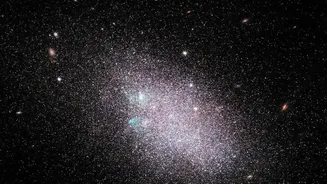
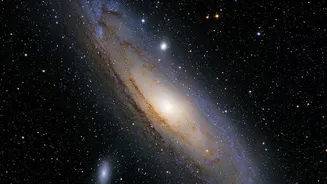
Our galaxy is not alone. It is surrounded by smaller, satellite galaxies, gravitationally bound to it in a cosmic dance. The largest of these after the Magellanic Clouds is the Sagittarius Dwarf Spheroidal Galaxy. For billions of years, this dwarf galaxy has
been on a collision course with the Milky Way, not once, but multiple times. It is in a polar orbit, meaning it dives through the main plane of our galaxy from above and below. Astronomers have long known that the Milky Way is slowly cannibalizing the Sagittarius galaxy, tearing it apart with immense tidal forces and absorbing its stars into long streams. But recent studies show this galactic David has had a profound and lasting impact on the Goliath it's colliding with.
The Cosmic Crime Scene
The evidence for this galactic restructuring comes from the European Space Agency's Gaia mission. Gaia is painstakingly creating a precise three-dimensional map of over a billion stars in our galaxy, tracking their positions, movements, and origins. This data has revealed strange ripples and perturbations in the movements of stars within the Milky Way's disc. Imagine dropping a stone into a still pond; the Sagittarius galaxy's repeated passages have sent similar waves through our galaxy's stellar disk. These disturbances were a major clue that a significant event had shaken the very foundations of the Milky Way.
Recreating History with Supercomputers
Armed with Gaia's unprecedented data, astronomers turned to powerful supercomputer simulations to rewind the clock. By modeling the gravitational interactions between the two galaxies over billions of years, they could see the full effects of the collisions. These models confirmed that the Sagittarius dwarf galaxy, especially its massive and invisible halo of dark matter, exerted a powerful gravitational pull on the Milky Way as it crashed through. Early simulations suggested these impacts were responsible for triggering the formation of the Milky Way’s iconic spiral arms and causing its disk to flare at the edges.
A Galaxy Flipped on Its Side
The most dramatic finding from recent models, presented in July 2026, concerns an even earlier and more massive collision with a different galaxy, nicknamed the Gaia Sausage. This event, occurring around 10 billion years ago, was so cataclysmic that it may have flipped the entire disc of the Milky Way by more than 90 degrees. Researchers at Durham University found that such a head-on collision would explain a long-standing mystery: why the stars in the Milky Way's outer halo rotate so much slower than stars in the main disk. The simulation showed that a major "disc flip" is a likely consequence of such a merger. While the Sagittarius collision is more recent and ongoing, the Gaia Sausage event was a defining moment that fundamentally set the orientation of our galaxy as we see it today.
An Evolving Cosmic Home
These discoveries paint a new picture of the Milky Way as a dynamic, evolving system rather than a static island of stars. The collisions have not only warped our galaxy's disk and tilted its halo, but they have also triggered massive bursts of star formation. In fact, some research suggests that one of the passages of the Sagittarius galaxy may have compressed the gas and dust cloud that eventually formed our own Sun, about 4.7 billion years ago. This means the very existence of our solar system could be linked to this violent galactic history. The Milky Way we inhabit has been profoundly shaped by these encounters, and the process is not over. The Sagittarius galaxy is expected to make another pass in about 10 million years, continuing to rain its stars and dark matter down onto our own.