



A Sweet Clue in the Cosmos
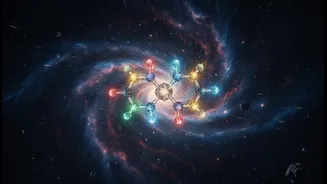
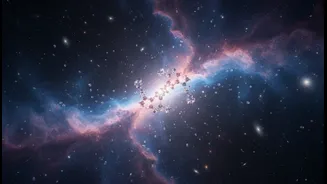
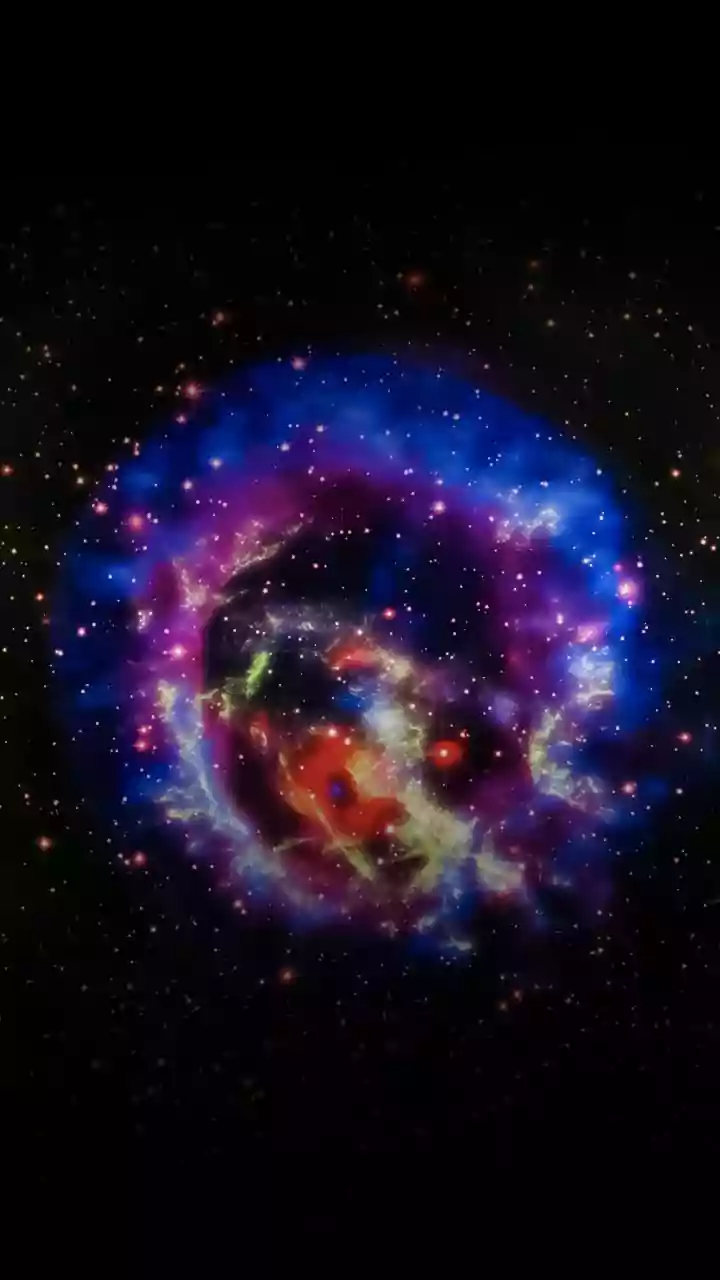
Scientists have announced the first-ever detection of a true sugar, called erythrulose, in interstellar space. This four-carbon sugar was identified by an international team led by researchers at Spain's Centre for Astrobiology, who were observing a molecular
cloud named G+0.693-0.027, located about 27,000 light-years away near the heart of the Milky Way. While other organic molecules have been found in space before, including simpler sugar-like molecules, this is the first time a more complex sugar has been unambiguously identified floating between the stars. On Earth, erythrulose is found in raspberries and is also used in sunless tanning products, but its discovery in space is significant for a very different reason: it belongs to the same chemical family as the sugars that form the backbone of RNA and DNA.
From Dust Grains to Planets
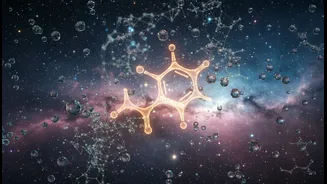
The discovery was made using powerful radio telescopes in Spain, which can detect the faint radio signals, or spectral fingerprints, that molecules emit as they rotate in space. The team picked up 12 distinct signals that perfectly matched the laboratory spectrum of erythrulose. The prevailing theory is that this sugar isn't floating freely but forms on the frigid surfaces of tiny interstellar dust grains. In these cosmic nurseries, where temperatures are around -250°C, simpler molecules like glycolaldehyde and ethylene glycol can combine to form more complex structures like erythrulose. These dust grains then get incorporated into comets and asteroids. Over billions of years, these cosmic delivery vehicles can crash into young planets, seeding them with the essential building blocks for life. Researchers estimate that millions of tonnes of erythrulose could have been delivered to early Earth during the Late Heavy Bombardment period about 4 billion years ago.
A New Recipe for Life
The finding challenges previous ideas about how complex molecules form in space. Scientists had generally thought that molecules grew sequentially, one carbon atom at a time. However, erythrulose, a four-carbon sugar, was found to be at least eight times more abundant than any similar three-carbon sugars in the same cloud, suggesting a different chemical pathway is at play. This points to a mechanism where larger, simpler molecules can merge to create more complex ones, a potentially more efficient route for prebiotic chemistry. As Dr. Izaskun Jiménez-Serra, the study's lead author, noted, this was an unexpected and exciting result. The presence of erythrulose is particularly thrilling because it's a potential precursor to molecules like ribose, the sugar that is a key component of RNA, which many scientists believe was the first genetic material on Earth.
The Cosmic Search Continues
This discovery adds a crucial piece to the puzzle of abiogenesis, the process by which life arises from non-living matter. While scientists had previously found sugars in meteorites that have landed on Earth, detecting them directly in the interstellar medium confirms that these key ingredients exist long before planets even form. It reinforces the idea that the universe is primed with the necessary chemicals for life to emerge. The detection of erythrulose opens the door for future searches for even more complex molecules. As co-author Carlos Briones stated, this discovery raises the possibility of finding other important sugars like ribose in space, bringing us one step closer to understanding our own cosmic origins. The find proves that the chemical groundwork for life begins not on planets, but in the cold, dark clouds between the stars.