




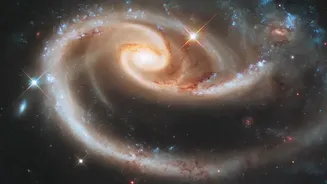

A New View of an Old Neighbour
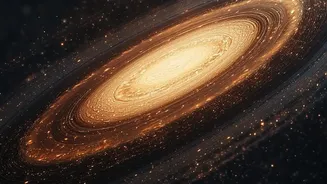
The Andromeda galaxy, also known as M31, is the closest major spiral galaxy to our own Milky Way, located a mere 2.5 million light-years away. For astronomers, it offers the perfect opportunity to study a galaxy like ours from the outside. The Panchromatic
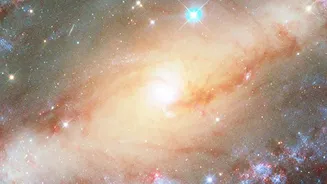
Hubble Andromeda Treasury (PHAT) survey, and its southern counterpart PHAST, represent one of the most ambitious projects ever undertaken by the Hubble Space Telescope. Over a decade, the telescope took hundreds of images, painstakingly stitched together to create a gigantic mosaic of our neighbour. This isn't just another pretty picture; it is a comprehensive census of a significant portion of Andromeda's sprawling stellar disk.
The Immensity of Scale
The sheer scale of the project is staggering. The final map is composed of billions of pixels and resolves over 100 million individual stars, with some recent analyses measuring around 200 million stars. Before Hubble, images of Andromeda showed it as a blurry swirl of light. Now, astronomers can pick out individual points of light within a vast stretch of the galaxy, covering a 61,000-light-year-long swath of its disk. The resolution is so powerful it’s like photographing a massive beach and being able to see individual grains of sand. This ability to resolve single stars is crucial, as each one acts as a tiny 'fossil' preserving a record of the galaxy's formation history. No other telescope can provide this level of high-resolution detail over such a large area of a neighbouring galaxy.
Colour as a Cosmic Clock
In this map, colour is much more than an aesthetic choice—it's a vital scientific tool. The survey captured images in six different filters, spanning from the ultraviolet through visible light to the near-infrared. This multi-wavelength approach allows scientists to determine the properties of each star. Young, massive stars burn hot and fast, giving them a distinct blue glow. Older, less massive, and cooler stars tend to appear redder. By analyzing the colour and brightness of the hundreds of millions of stars in the map, astronomers can effectively take a demographic survey of the galaxy, identifying which regions are galactic nurseries, filled with young blue stars, and which are quiet retirement communities of older, yellow and red stars.
Reading Galactic History in the Stars
Combining the data on scale and colour allows astronomers to determine the stellar ages across the galaxy, turning a static image into a dynamic history. By mapping where the old and young stars live, they can reconstruct Andromeda's past. Recent analysis of this data has revealed a fascinating story. About two billion years ago, Andromeda appears to have experienced a major burst of star formation, possibly triggered by an interaction with another galaxy. However, in the more recent past, things have quieted down. Studies show that over the last 500 million years, star formation in Andromeda has been steadily declining, with an even sharper drop in the last 40 million years. The galaxy is transitioning from a vibrant, active phase into a more quiescent middle age.
Lessons for the Milky Way
Studying Andromeda in such detail isn't just about understanding our neighbour; it's also about understanding ourselves. Since we are inside the Milky Way, it's incredibly difficult to get a complete, bird's-eye view of our own galaxy's structure and history. Andromeda serves as an external proxy, a template for how large spiral galaxies form and evolve. The insights gained from the PHAT survey—from its merger history to its declining star formation—provide a crucial context for our own galaxy's life story and its eventual fate. In about 4 billion years, the Milky Way and Andromeda are predicted to collide and merge, a dramatic event for which this incredible map provides a detailed 'before' picture.