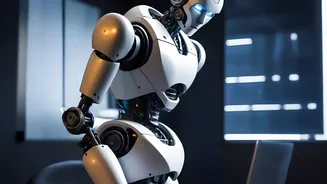



The rise of Artificial Intelligence in hiring is causing many to question the future of recruitment. Yet, the narrative isn't about replacement. It's about a powerful synergy where technology's speed meets the irreplaceable wisdom of human experience.
AI’s Role as the Ultimate Assistant
Artificial Intelligence is rapidly transforming how companies find talent. AI-powered tools can sift through thousands of applications in minutes, screen resumes for specific keywords, schedule interviews, and even handle initial candidate communications with chatbots. This level of automation handles the repetitive, high-volume tasks that often consume a recruiter's day. The primary advantage is efficiency. By automating these initial steps, organisations can significantly shorten the time-to-hire, reduce manual workloads, and process a larger volume of applicants faster than ever before. This allows human recruiters to redirect their energy from administrative work to more strategic functions.
The Irreplaceable Value of Human Experience
Despite AI's power, it has significant limitations. Algorithms operate on data and predefined criteria, but they cannot replicate the nuanced understanding that comes from years of practical experience. An experienced professional brings context, intuition, and deep industry knowledge that an AI cannot possess. They can assess a candidate's cultural fit, leadership potential, and problem-solving style in ways that go beyond keywords on a resume. Skills like emotional intelligence, adaptability, creativity, and complex collaboration are inherently human and are often honed through real-world challenges. A seasoned employee doesn't just know the 'what'; they understand the 'why' and 'how'—wisdom gained from navigating successes, failures, and complex workplace dynamics.
The Dangers of Relying Solely on AI
Leaning too heavily on AI in hiring carries risks. A major concern is algorithmic bias. If an AI is trained on historical hiring data from a company with a non-diverse workforce, it may learn to replicate those biases, unfairly filtering out qualified candidates from underrepresented groups. Furthermore, AI algorithms can operate as 'black boxes', making it difficult to understand why a certain decision was made, which can lead to a lack of transparency and trust for candidates. An over-automated process can also feel impersonal and alienating, potentially discouraging top talent who value human connection and a positive candidate experience.
The Hybrid Model: AI and Humans Working Together
The most effective approach to modern hiring is a hybrid one that blends AI's efficiency with human insight. In this model, AI serves as a powerful support system, not the final decision maker. It handles the initial, data heavy screening, while human recruiters focus on the high value aspects of hiring building relationships conducting in depth interviews and making the final judgment call. This collaborative approach ensures that decisions are not just fast and data informed but also context aware and fair. Human oversight is crucial to audit AI tools for bias interpret their outputs and ensure that the process remains equitable and transparent.
How Experienced Staff Can Thrive
For experienced professionals, the key to thriving in the age of AI is to lean into uniquely human strengths. As AI handles more routine tasks, skills like critical thinking, strategic planning, mentorship, and complex problem solving become even more valuable. Practical expertise—the ability to apply knowledge in messy, real world situations—is a critical differentiator. Experienced employees are not just individual contributors; they are mentors, leaders, and keepers of institutional knowledge. By focusing on developing and demonstrating these higher level cognitive and interpersonal skills, seasoned professionals can position themselves as indispensable partners to AI, not competitors.