




The Cosmic Detective's Toolkit
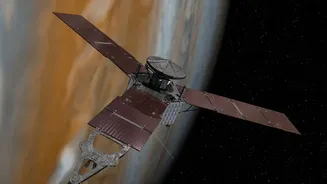
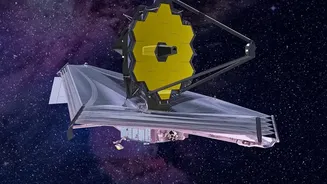
At the forefront of this ambitious quest is the James Webb Space Telescope (JWST). This powerful observatory is humanity's primary tool for peering into the atmospheres of exoplanets, worlds orbiting distant stars. It operates on a simple but brilliant
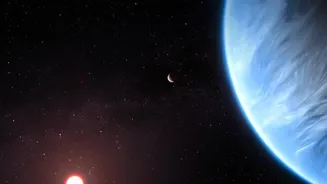
principle called transit spectroscopy. As an exoplanet passes in front of its host star from our perspective, a tiny fraction of the starlight filters through the planet's atmosphere. By analyzing this light, scientists can detect the chemical fingerprints of gases present, including the one most crucial for life as we know it: water. Each molecule absorbs light at specific wavelengths, leaving a unique signature in the spectrum that JWST can read. This allows astronomers to build a profile of an alien world's air from light-years away.
Hunting for a Telltale Sign: Water
Finding water, even as vapor, is a monumental step in prioritizing which exoplanets deserve a closer look. On Earth, water is fundamental to every known form of life, so its presence elsewhere is considered a key potential indicator of habitability. Recent observations have highlighted JWST's incredible capability in this area. It has detected water vapor in the atmospheres of multiple exoplanets, from hot gas giants to smaller, rocky worlds. For instance, recent studies have confirmed water-ice clouds on a super-Jupiter and are analyzing potential water signatures on a range of other planets. While this is not proof of oceans or life, it confirms that a critical ingredient for life can and does exist beyond our solar system, narrowing the search for potentially habitable environments.
Why the Star Matters
However, just looking at the planet is not enough. The headline's mention of "changing stars" points to a crucial complication: stellar variability. The host stars of these planets are not perfectly stable balls of light. Many are 'patchy,' with cooler, darker starspots and hotter, brighter regions called faculae that rotate in and out of view. These stars can also erupt with powerful flares. This activity causes the star's brightness to fluctuate, creating a variable background against which astronomers are trying to measure the minuscule dip in light from a transiting planet. Understanding the star's behavior is therefore just as important as studying the planet itself.
The Challenge of a Fickle Sun
A variable star can severely complicate the search for atmospheric signals. If a planet passes in front of a brighter, hotter part of its star, it can appear larger or have a denser atmosphere than it really does. Conversely, passing over a dark starspot could make it seem smaller. Worse, the chemical signatures of features on the star's surface can sometimes mimic or obscure the very signals scientists are looking for, such as water vapor. This means that without carefully accounting for the star's activity, researchers could misinterpret the data, leading to incorrect conclusions about a planet’s size, temperature, and atmospheric composition. A new NASA mission, Pandora, is specifically designed to tackle this problem by observing planets and their stars simultaneously to disentangle their signals.
A Two-Part Investigation
To get an accurate picture, scientists must now conduct a two-part investigation for every target. First, they observe the exoplanet's atmosphere using instruments like JWST's spectrographs. Second, they meticulously monitor the host star over time, mapping its spots, flares, and rotational patterns. By building a precise model of the star's behavior, they can effectively subtract its 'noise' from the planetary data. This reveals the true signal from the exoplanet's atmosphere. It’s like trying to listen to a faint whisper in a loud, fluctuating room; you first need to understand the pattern of the background noise before you can make out the words. This dual approach is essential for confidently confirming the presence of key molecules.