








A 50-Year Cosmic Mystery Solved
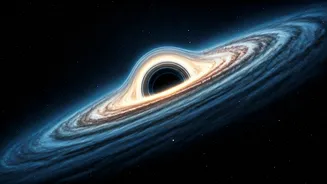
For half a century, a quiet puzzle has persisted at the center of our galaxy. Theory predicted that all black holes, as they consume matter, should also push some of it away in the form of powerful winds or jets. Yet Sagittarius A (Sgr A), the four-million-solar-mass
black hole at the heart of the Milky Way, showed no signs of such an outflow. This absence made our galactic center seem like an oddity. But after years of painstaking observation, a team of astronomers has finally detected the faint imprint of this long-sought-after wind, confirming that our black hole is not so unusual after all. As one researcher put it, after analyzing the data, they could finally say, 'There it is. There is the thing that everybody's been looking for for 50 years.'
Seeing the Invisible
Detecting this galactic breath was a monumental challenge. Sgr A is about 26,000 light-years away, and to see it, we have to peer through the dense gas and dust of the Milky Way's plane. Furthermore, our black hole is a very tidy eater. Compared to the ravenous black holes in other galaxies, which create brilliant fireworks, Sgr A is in a quiet phase, consuming the equivalent of a single grain of rice every million years. This makes its wind incredibly faint. The breakthrough came from combining five years of observations from the Atacama Large Millimeter/submillimeter Array (ALMA) in Chile. Astronomers created the most detailed map ever of the cold gas near the black hole and, by carefully subtracting the bright glare of Sgr A itself, they uncovered something remarkable: a giant, cone-shaped hole in the gas.
The Shape of a Black Hole's Breath
This newly discovered cavity, about three light-years long, points directly away from the black hole. It looks as if something has pushed all the cold gas out of the way. To be sure this wasn't just a glitch in the data, the team turned to another powerful instrument, NASA's Chandra X-ray Observatory. The Chandra data showed that this very same cavity was filled with hot, glowing gas. The perfect alignment of the cold-gas void and the hot-gas plume gave scientists confidence: this was the signature of an outflow. The wind from Sgr A appears to have been blowing for at least 20,000 years, heating the gas or sweeping it aside entirely to create the structure we now see.
A Window into a Quiet Giant
So what does this all mean? The discovery confirms that Sgr A* isn't a cosmic weirdo; it follows the same fundamental rules as other supermassive black holes, just on a much quieter scale. This is incredibly valuable because most other galaxies are too far away for us to study in this detail. We usually only notice their central black holes when they are in a brief, spectacularly violent 'fireworks' phase. Our own galaxy's center provides a unique laboratory to study the dominant, quiet state that most black holes are in for the majority of their lives. It helps us understand the subtle, long-term ways that even a slumbering giant can shape its environment, regulating star formation and the evolution of the galaxy around it.