





More Than a Model Railway
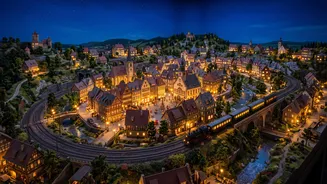
To call Miniatur Wunderland just a model railway is an understatement. It is a sprawling, living world built on an epic scale. Conceived by twin brothers Frederik and Gerrit Braun, the attraction has grown into one of Germany's most popular destinations.
Spanning over 1,600 square meters of model space, it features more than 16,000 meters of track. But the trains are just the beginning. The exhibit is a detailed love letter to different parts of the globe, with sections dedicated to Hamburg, the Alps, America, Italy, and even Patagonia. Every 15 minutes, the entire world cycles from day to night, with nearly 500,000 LEDs illuminating the tiny streets, buildings, and vehicles in a stunning transformation.
The Heartbeat of the City
What truly breathes life into the miniature cities is the revolutionary car system. Far from being static props, over 350 vehicles navigate the streets autonomously. This isn't a simple loop; it's a complex, computer-controlled traffic simulation. Cars follow a guide wire embedded in the road, powered by on-board batteries. The custom software, which took thousands of hours to develop, calculates options for each car 20 times per second. Vehicles obey traffic lights, yield to emergency services, and even get caught in speed traps. They have headlights that turn on at dusk and hazard lights that blink in a traffic jam. This intricate dance of tiny vehicles, from city buses making scheduled stops to fire trucks racing to an incident, creates a mesmerizing and believable urban pulse that you can watch for hours.
A World of Tiny Stories
The true soul of Wunderland is its population of nearly 290,000 tiny residents. These H0 scale figures are not just placed randomly; they are arranged into thousands of miniature scenes that tell stories, often with a humorous or surprising twist. A close look reveals everything from everyday life to fantastical events. You might find a couple on a romantic date, a police raid, a traffic accident, or even a flying UFO. In one section, 21,000 fans pack an open-air concert, while in another, a chocolate factory dispenses real miniature chocolates. Each of these dioramas is a testament to the creativity and attention to detail of the model makers, who spend countless hours setting up these tiny narratives that invite visitors to look closer and discover the hidden jokes and dramas of the Wunderlandians.
The Magic Behind the Curtain
The seamless operation of this miniature world is a staggering technological achievement. More than 40 computers run the complex systems that coordinate everything from the 1,200 trains to the tide rising and falling in the Scandinavia section. A central control room, visible to visitors, looks like a real-world traffic control center, with operators monitoring dozens of screens to ensure everything runs smoothly. Building a single, tech-filled vehicle can take up to 45 hours, as each one contains a microprocessor to control lights, speed, and battery monitoring. The team developed its own reliable communication system to send commands to the cars after finding standard infrared to be insufficient for such a large and complex layout. This blend of meticulous craftsmanship and cutting-edge software engineering is what allows Wunderland to feel less like a model and more like a parallel, pocket-sized reality.