
The Cosmic Centerpiece
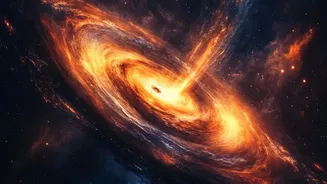
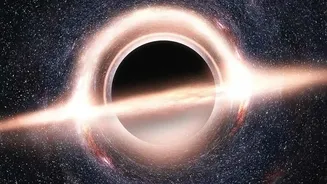
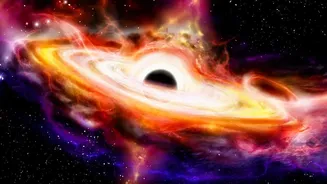
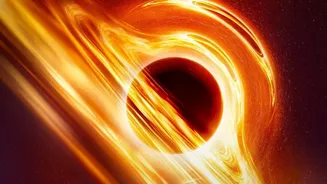
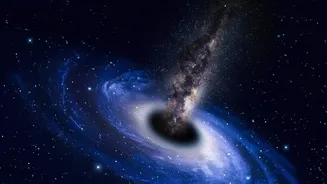
Think of almost any large galaxy, including our own Milky Way, and you'll find a monster lurking in the middle: a supermassive black hole. These cosmic behemoths, with masses millions or even billions of times that of our sun, are the gravitational anchors
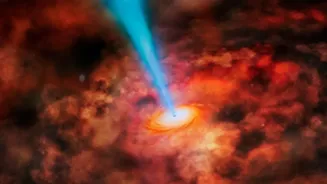
of their galactic homes. They are so fundamental to galaxy structure that astronomers have long believed there's an intimate connection between the size of a galaxy and the size of its central black hole. For decades, the search for these giants has focused exclusively on the dense, star-packed core of galaxies, because that's simply where they are supposed to be. The immense gravity of the galactic center provides a steady diet of gas and stars, occasionally lighting up as an 'active galactic nucleus' or AGN.
An Unexpected Discovery in the Outskirts
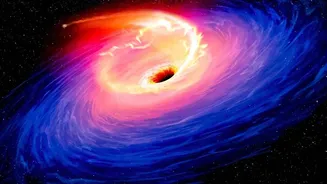
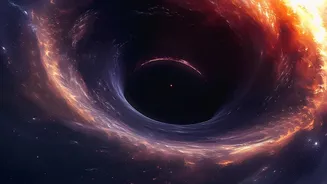
Recently, astronomers received a major surprise. Thanks to NASA's Neil Gehrels Swift Observatory and the Zwicky Transient Facility (ZTF), they spotted an intense flash of light from the outskirts of a galaxy 750 million light-years away. This wasn't a supernova, but a tidal disruption event (TDE) — the tell-tale sign of a black hole tearing apart a star that wandered too close. The flare briefly outshone its entire host galaxy. What made this event, catalogued as TDE 2025abcr, so shocking was its location. The black hole responsible was found lurking 30,000 light-years away from its galaxy's center, in a quiet, seemingly empty region of space. This was the first time a dormant, wandering supermassive black hole had been found so far from a galactic core.
Why is a Wandering Black Hole So Strange?
Finding a supermassive black hole this far out is like finding a city's central train station in a quiet suburb. It defies our models of how galaxies are built. Supermassive black holes are thought to grow by consuming material at the galaxy's core, where gas and stars are most concentrated. An off-center black hole is starved of this fuel, making it 'quiescent' or dormant and therefore invisible. This discovery was only possible because of the unlucky star that got shredded, lighting up the darkness and revealing the black hole's hiding place. It confirms a long-held theory that such 'wandering' black holes should exist, but until now, we had never seen such a clear example. This raises a huge question: how many more are out there, silently roaming the galactic frontiers?
The Prime Suspect: Galactic Collisions
So, how does a supermassive black hole end up on the run? The leading theory points to a violent past involving galaxy mergers. When two galaxies collide, their central black holes will eventually spiral toward each other and merge. These cosmic collisions are incredibly chaotic. One possibility is that the smaller of two merging galaxies was stripped of its stars by the larger one, leaving its central black hole to wander the outskirts of the new, combined galaxy. Another, more dramatic scenario involves a 'gravitational wave recoil'. The merger of two black holes can release a tremendous blast of gravitational waves in one direction, causing the newly formed, larger black hole to get a powerful 'kick' in the opposite direction, potentially ejecting it from the galactic center entirely.
Rewriting Our Understanding of the Universe
This discovery does more than just confirm that wandering black holes are real. It forces astronomers to rethink key aspects of galaxy evolution. Models that assume black holes always stay in the center may need significant revision. An off-center black hole can't regulate star formation in its host galaxy in the same way a central one does, which could change how the galaxy grows and ages. Furthermore, finding these objects validates new search techniques, like using artificial intelligence to scan for off-center TDEs. With next-generation observatories coming online, astronomers are now poised to hunt for more of these hidden wanderers, creating a census of rogue black holes and painting a more complete picture of our dynamic and often violent universe.