






Meet Ganymede, the King of Moons
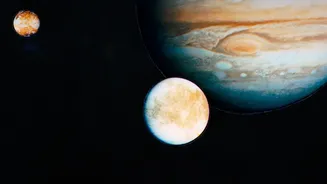
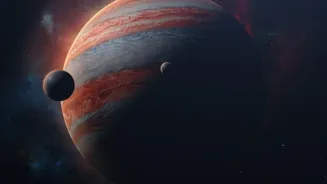
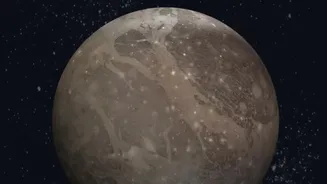
Ganymede is the undisputed giant among the solar system's moons. Discovered by Galileo Galilei in 1610, it is one of Jupiter's four largest satellites, aptly named the Galilean moons. But its size is what truly sets it apart. With a diameter of over 5,260
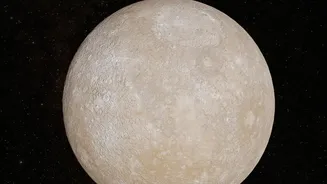
kilometres, Ganymede is not only the largest moon but is also larger than the dwarf planet Pluto and even the planet Mercury. If it were orbiting the Sun instead of Jupiter, it would almost certainly be classified as a planet based on its size alone. However, despite its impressive size, it has only about half the mass of Mercury, due to its composition of rock and a large amount of water ice, which makes it less dense.
A World with a Planet's Heart
What makes Ganymede so planet-like goes far beyond its size. Like Earth, it is a fully differentiated body, meaning its insides have settled into distinct layers. Deep within, it has a liquid, iron-rich core. The convection within this metallic core is believed to be the engine that generates something extraordinary for a moon: its own magnetic field. This feature, discovered by NASA's Galileo spacecraft in 1996, is unique among all the moons in our solar system. Planets like Earth, Jupiter, and Mercury have magnetic fields, but for a moon to generate its own is a sign of remarkable internal complexity.
An Ocean World in Disguise
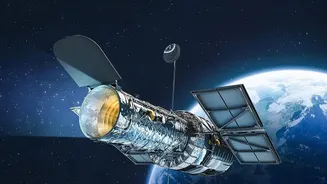
Adding to its planetary resume, scientists have gathered strong evidence that Ganymede is hiding a massive secret beneath its icy crust: a subterranean saltwater ocean. Evidence from the Hubble Space Telescope, which observed the rocking motion of Ganymede's auroras—glowing ribbons of gas created by its magnetic field—suggests the presence of a vast body of conductive liquid. This ocean is thought to be about 100 kilometres deep, meaning it could contain more water than all of Earth's surface oceans combined. The potential for a liquid water ocean, a key ingredient for life as we know it, makes Ganymede a prime target for future exploration missions like the European Space Agency's JUICE (Jupiter Icy Moons Explorer).
So, What Is the Deciding Factor?
With its impressive size, layered structure, magnetic field, and vast ocean, Ganymede seems to check many of the boxes for a planet. So why is it still considered a moon? The answer is simple and comes down to one crucial detail: its address. According to the International Astronomical Union, the official definition of a planet requires a celestial body to do three things: orbit the Sun, be massive enough for its own gravity to make it nearly round, and have "cleared the neighbourhood" around its orbit. While Ganymede is round and certainly a massive object, it fails on the first and most important rule. It orbits Jupiter, not the Sun. This simple fact makes it, by definition, a natural satellite, or moon.