




A Symphony on a Leaf
The Onam Sadya, the traditional banquet of Kerala's harvest festival, is more than just a meal; it's a culinary philosophy. Each of the 20-plus vegetarian dishes has a specific place and purpose, designed to create a harmonious balance of sweet, sour,
salty, spicy, bitter, and astringent tastes. This elaborate spread, served on a single banana leaf, is a celebration of abundance and togetherness. From crunchy chips and tangy pickles to rich curries and sweet payasams, every element is meant to complement the others, creating a complete and satisfying experience. Among these varied offerings, two yogurt-based dishes, Pachadi and Kichadi, play a crucial role as balancing agents, yet they are frequently mistaken for one another.
Pachadi: The Sweet and Tangy Star
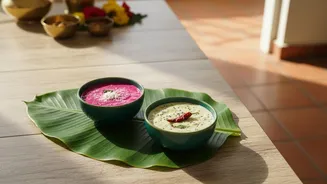
Pachadi is perhaps the more versatile and flavourfully complex of the two. It is a yogurt-based side dish that often leans towards a sweet and sour profile, though it can also be spicy. The defining characteristic of most pachadi recipes is the use of ground mustard seeds in the coconut paste. This imparts a signature pungency that beautifully cuts through the sweetness of its main ingredient, which can be a fruit like pineapple or ripe mango, or a vegetable like beetroot. The main vegetable or fruit is cooked and then mixed into a base of yogurt and a freshly ground paste of coconut, cumin, green chillies, and that all-important mustard. The result is a vibrant, multi-layered dish that can be sweet, tangy, and slightly spicy all at once, acting as a brilliant palate-cleanser.
Kichadi: The Cooling, Mild Counterpart
If Pachadi is the vibrant star, Kichadi is its cool and calming counterpart. Kichadi is also a yogurt-based dish, but it is typically milder and primarily tangy rather than sweet. It is almost always made with vegetables, most commonly cooling ones like cucumber, ash gourd, or okra. The fundamental difference lies in the ground coconut paste: Kichadi's paste is simpler, usually a blend of just coconut and cumin, omitting the pungent mustard seeds that define Pachadi. Some simple Kichadi variations might even skip the coconut paste altogether, relying solely on cooked vegetables mixed into whisked yogurt. Its primary role is to be a soothing, gentle accompaniment, providing a refreshing contrast to spicier dishes on the Sadya leaf.
The Core Differences at a Glance
Though both are yogurt-based relishes essential to the Sadya, the confusion ends when you look at the details. The main distinction lies in the coconut paste: Pachadi includes raw mustard seeds, giving it a characteristic sharp, pungent note, while Kichadi does not. Consequently, Pachadi often features sweet ingredients like pineapple to balance this pungency, resulting in a sweet-and-sour flavour profile. Kichadi, on the other hand, is almost always savoury and made with watery vegetables like cucumber, providing a milder, more cooling effect. While family recipes vary, this mustard-or-no-mustard rule is the most reliable way to tell these two delicious dishes apart. Think of Pachadi as the complex, sweet-and-tangy performer and Kichadi as the simple, cooling peacemaker.
Their Essential Role in the Feast
On the banana leaf, both Pachadi and Kichadi are served on the upper half, along with other side accompaniments. Their placement and purpose are strategic. As you progress through the meal, mixing rice with different curries like Sambar or the tangy Rasam, a small scoop of Pachadi or Kichadi offers a delightful break. The sweetness of a pineapple pachadi can temper the heat of a spicy curry, while the cooling effect of a cucumber kichadi can refresh the palate, preparing it for the next course. They are not main curries but flavourful accents that embody the Sadya’s core principle: creating a perfectly balanced and harmonious eating experience, where every single dish has a role to play in the grand culinary performance.