



A Partially Successful Flight With a Historic Finish
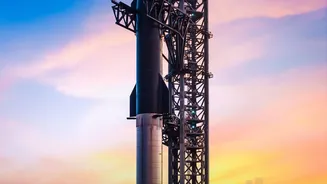
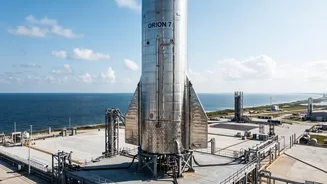
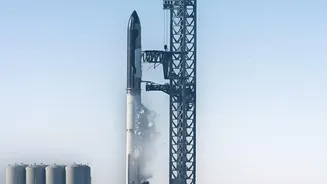
SpaceX's 15th Starship test flight lifted off from Starbase, Texas, on November 13 with an ambitious goal: to launch and then recover both parts of the giant rocket system. The plan was to catch both the Super Heavy booster and the Starship upper stage
using the launch tower's arms. While the mission was only a partial success, its conclusion was spectacular. The Super Heavy booster, after propelling the Starship skyward, experienced an issue with low fuel mass during its return burn. This triggered an automated abort, causing it to divert for a safe splashdown and subsequent destruction in the Gulf of Mexico. The Starship upper stage, however, continued its mission flawlessly. It reached orbit, deployed 26 Starlink satellites, and spent nearly a full day circling the Earth before beginning its descent. Roughly 22.5 hours after launch, on November 14, the world watched as Ship 42 was successfully caught by the launch tower, a first in the history of spaceflight.
The 'Chopsticks': How the Catch Works
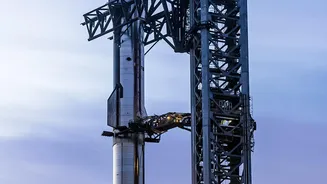
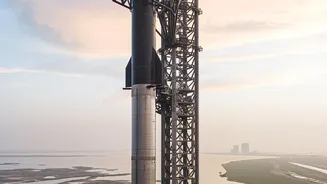
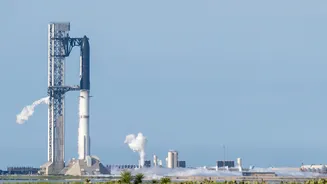
The system at the heart of this achievement is a massive launch and recovery tower that SpaceX founder Elon Musk has nicknamed 'Mechazilla'. The nearly 146-meter-tall structure is equipped with two large, hydraulically actuated arms, often called 'the chopsticks'. These arms are designed to perform the dual function of stacking the rocket before launch and catching it upon its return. The returning Starship performs a 'belly flop' maneuver to slow itself during atmospheric reentry before firing its Raptor engines to flip into a vertical position. It then navigates to a precise point between the tower's open arms, which close around two reinforced catch fittings on the vehicle's body, securing it in mid-air. This innovative system eliminates the need for heavy landing legs on the vehicle itself, saving weight and enabling a faster turnaround for the next launch.
Why Catching a Starship Is a Game-Changer
The successful catch of the Starship upper stage is more than just an engineering spectacle; it's a fundamental step toward making spaceflight radically cheaper and more accessible. For decades, rockets have been largely expendable, with expensive upper stages burning up in the atmosphere after a single use. SpaceX's Falcon 9 rocket pioneered the recovery of first-stage boosters, but Starship aims to create the world's first fully and rapidly reusable orbital launch system. By recovering and reusing both the booster and the ship, SpaceX could slash the cost of getting to orbit. This is analogous to the difference between discarding an airplane after every flight versus refueling and flying it thousands of time. This massive cost reduction and the ability to launch far more frequently are essential for SpaceX's ambitious plans, including building out its next-generation Starlink satellite internet constellation.
Paving the Way for the Moon and Mars
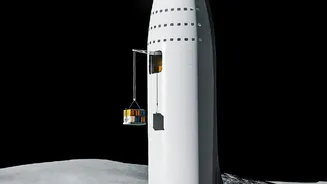
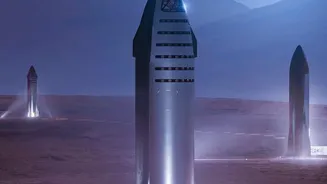
Full reusability is the key technology that unlocks humanity's future as a multi-planetary species. NASA has already selected a version of Starship to be the lander that will return astronauts to the lunar surface for its Artemis program, with the first crewed landing targeted for 2028 on the Artemis IV mission. Reaching the Moon will require Starship to refuel in Earth's orbit, a complex maneuver involving multiple launches of 'tanker' Starships to fill up a propellant depot in space. The ability to launch, catch, and quickly relaunch the same vehicles makes this orbital refueling concept economically viable. Beyond the Moon, Elon Musk's ultimate goal for Starship has always been the settlement of Mars. A fleet of fully reusable Starships, capable of carrying hundreds of tons of cargo and dozens of passengers, is the foundation of his plan to establish a self-sustaining city on the red planet.