



1. Armero, Colombia (1985): Heed the Warnings
When the Nevado del Ruiz volcano erupted, it wasn't the lava that caused the catastrophe, but the resulting lahars—fast-moving mudflows from melted glaciers. Despite weeks of volcanic activity and warnings from scientists to evacuate, a series of communication
failures and official reassurances left the town of Armero tragically unprepared. The lahars buried the town, leading to over 23,000 deaths. The lesson from Armero is stark and unequivocal: scientific warnings must be translated into decisive action. Ignoring them, or allowing the message to be diluted by politics or public complacency, can lead to almost unimaginable loss.
2. Aberfan, Wales (1966): Man-Made Mountains Matter, Too
Not all mountain risks are natural. In Aberfan, a colliery spoil tip—a massive pile of mining waste—was dumped on a mountainside above the village, directly over underground springs. After days of heavy rain, the saturated tip collapsed, sending a slurry of waste into the village and engulfing a primary school. The disaster killed 144 people, including 116 children. Investigations revealed a history of negligence and ignored warnings from villagers. The tragedy of Aberfan teaches that human activity can create its own mountains of risk. It underscored the absolute necessity of stringent engineering regulations, corporate accountability, and listening to community concerns.
3. Ancash, Peru (1970): The Dual Threat of Quake and Avalanche
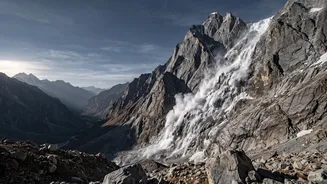
The deadliest avalanche in recorded history was triggered by an earthquake. A 7.9 magnitude quake off the coast of Peru destabilised the northern wall of Mount Huascarán. A massive slab of rock and glacial ice broke loose, creating a debris avalanche that traveled at hundreds of kilometers per hour. It completely buried the town of Yungay, where only a few hundred of its thousands of inhabitants survived. The Ancash event demonstrates the terrifying synergy of mountain hazards, where an earthquake can unleash a secondary, even more destructive, force. It highlights the vulnerability of communities in seismically active mountain ranges to complex, cascading disasters.
4. Mount St. Helens, USA (1980): Respect the Exclusion Zone
The 1980 eruption of Mount St. Helens was one of the most well-monitored in history. Scientists had a good idea it was coming, prompting authorities to establish exclusion zones. However, pressure from landowners and sightseeing tourists led to difficulties in enforcing these zones. When the volcano finally erupted with catastrophic force, 57 people were killed—many of whom were inside areas designated as unsafe. The event became a powerful lesson in risk communication and the importance of establishing and strictly enforcing clear, science-based exclusion zones, even when faced with public resistance.
5. Galtür, Austria (1999): When 'Safe' Isn't Safe Enough
The alpine village of Galtür was protected by a hazard zoning system that was considered state-of-the-art. Yet in February 1999, after an unprecedented period of heavy snow and high winds, a massive powder avalanche descended into an area that had been designated as a safe 'yellow zone'. The avalanche was far larger than historical precedent suggested was possible, killing 31 people. Galtür's lesson is that historical data and existing models have limits. In an era of changing climate patterns, communities must constantly reassess risk, update their hazard maps, and invest in physical defences like dams and reinforced buildings, because the disasters of the future may not resemble those of the past.
6. Gorkha, Nepal (2015): Buildings Are the First Line of Defence
When a 7.8 magnitude earthquake struck Nepal, the vast majority of the nearly 9,000 fatalities were caused by collapsing buildings. While Nepal had a building code, widespread non-compliance, poor construction practices, and the use of inadequate materials meant that countless structures simply could not withstand the shaking. From multi-story concrete frames with soft ground floors to traditional unreinforced masonry, the failures were systemic. The Gorkha earthquake is a brutal reminder that in a seismic zone, a building code is not a suggestion. The most critical element of survival is the structural integrity of the homes, schools, and offices people occupy every day. Enforcement and quality construction are paramount.
7. Chamoli, India (2021): Climate Change is a New Variable
The Chamoli disaster began when a massive wedge of rock and glacier ice broke off a peak in the Himalayas. The resulting debris flow devastated the valley below, destroying two hydropower projects and killing over 200 people. While not directly attributed to climate change, scientists noted that warming temperatures can degrade the permafrost and ice that acts as 'glue' on steep mountain faces, potentially increasing the frequency of such events. Chamoli highlights a modern lesson: infrastructure and development in high-mountain regions must now account for new, unpredictable risks amplified by a changing climate.