








Meet the New V5 Residential Dish
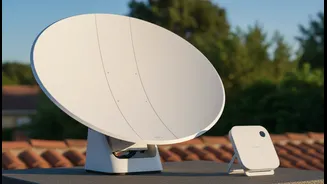
SpaceX has officially unveiled its latest residential hardware, the Starlink V5 kit. This isn't a simple cosmetic update; it's a significant redesign focused on efficiency and ease of use. The most dramatic change is its size and weight. The V5 dish weighs
just 1.1 kg (2.4 pounds), less than half the weight of its V4 predecessor, which tipped the scales at 2.9 kg. This makes installation far easier for the average homeowner. Power consumption has also been slashed, with the V5 drawing an average of 35-50 watts, compared to the 75-100 watts of the V4. This makes it a much more viable option for users in off-grid homes or those relying on solar power. While the new dish is smaller, lighter, and more efficient, its peak speed is rated slightly lower at 375+ Mbps, compared to the V4's 400+ Mbps, a minor difference most home users are unlikely to notice in daily use.
A Clearer Role for the Starlink Mini
The introduction of the V5 clarifies the distinct roles of Starlink's hardware. While the V5 is becoming the new standard for fixed home internet, the Starlink Mini is solidifying its position as the go-to solution for true portability. The V5's weight is now on par with the Starlink Mini, but their intended uses are completely different. Starlink explicitly states the V5 is not designed for in-motion use, a key feature of the mobile-focused plans. The Mini, on the other hand, is built for travel, with an integrated router and the ability to be powered by a variety of DC sources, including portable power banks. This strategic separation allows Starlink to optimize each device for its primary function: the V5 for stable, power-efficient home use, and the Mini for maximum portability for campers, RVers, and digital nomads.
The Strategy Behind the Split
This hardware divergence signals a maturing business strategy. Rather than a one-size-fits-all approach, Starlink is now creating specific products for different market segments. By making the residential V5 dish lighter and more power-efficient, SpaceX addresses key concerns for homeowners, especially those in remote or off-grid locations. Meanwhile, continuing to develop the ultra-portable Mini caters to the growing market of mobile users who prioritize convenience and portability over raw power. This product segmentation allows Starlink to compete more effectively across the board. It can offer a more user-friendly installation for permanent setups while simultaneously capturing the mobile market that competitors are also targeting. The move also streamlines the product lineup, making it easier for new customers to choose the right hardware for their needs, whether it's for a fixed address or life on the road.
What Does This Mean for Customers?
For new residential customers in select areas, the V5 is becoming the new default. It's currently being rolled out in parts of the United States, bundled with the company's Residential plans. Initially, it appears to be available with the most affordable residential tier. The kit comes with a pipe adapter for easier roof installation and a new, smaller Router Mini. For prospective mobile users, the choice is now clearer: the Starlink Mini, used with a Roam plan, is the purpose-built solution. Existing customers with V4 dishes are not affected and their hardware will continue to function as normal. However, the V5's lower power draw and lighter weight might make it an attractive upgrade for some, particularly those powering their systems with batteries or solar. This new lineup simplifies the decision-making process by aligning specific hardware with specific use cases—a welcome clarification for a rapidly expanding customer base.