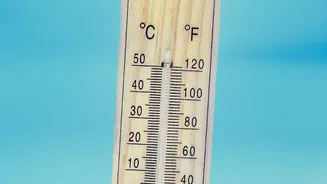







Weather's Sprint vs. Climate's Marathon
The most important distinction to grasp is the one between weather and climate. Think of weather as your daily or monthly mood—it can fluctuate wildly. A heatwave can make one month extraordinarily hot, just as a cold snap can make the next surprisingly
chilly. That's weather. Climate, on the other hand, is the long-term personality. It’s the average of all those weather fluctuations over many years, even decades. A single hot month is a weather event. Climate change, and the targets designed to fight it, are concerned with the long-term trend, the slow but steady shift in that overall personality. So, when scientists see a single month spike by 2°C, they see a concerning weather data point, but they don't see it as a breach of a long-term climate goal.
What the Paris Agreement Actually Targets
The landmark Paris Agreement has a very specific goal: to keep the long-term increase in global average temperature to “well below 2°C above pre-industrial levels” and to pursue efforts to limit it to 1.5°C. The key words here are “long-term.” The agreement was never designed to be judged on the temperature of a single month or even a single year. Climate scientists at bodies like the World Meteorological Organization (WMO) and the Intergovernmental Panel on Climate Change (IPCC) typically define a climate period as 20 or even 30 years. This long timeframe allows them to smooth out the 'noise' of natural, short-term variations like El Niño and La Niña cycles, which can temporarily push global temperatures up or down for a year or two. A permanent breach of the Paris target would mean the 20-year average temperature is consistently above the 1.5°C or 2°C threshold.
A Warning Sign, Not a Final Verdict
This doesn't mean that monthly or annual temperature records are meaningless. On the contrary, they are urgent warning signs. Scientists see these temporary breaches as a clear signal that we are getting “perilously close” to the long-term limits. The year 2024, for instance, was the first full year where the global average temperature rose more than 1.5°C above pre-industrial levels. While this isn't a technical breach of the Paris Agreement's long-term goal, it's a sobering preview of the world we are heading towards if we don't change course. These record-breaking years are like a fever spike in a patient; it doesn't mean the underlying illness is terminal, but it’s a powerful and alarming symptom that demands immediate and serious action. The increasing frequency of these spikes shows that the underlying warming trend, driven by human emissions, is accelerating.
Why This Nuance Is Critical
Understanding this distinction is vital for public morale and effective policy. If we mistakenly believe that a single hot year means we have failed, it can lead to despair and apathy. Climate change is a decadal challenge that requires sustained commitment, not a pass/fail test that resets every month. Declaring “game over” prematurely plays into the hands of those who promote inaction and disinformation, which thrive on confusion and a sense of hopelessness. The real goal is to reduce greenhouse gas emissions consistently over the long run to bend the warming curve downwards. This requires a focus on systemic changes in energy, transport, and industry. Knowing that a monthly spike is not a permanent failure allows us to treat it as a motivator for more aggressive action, rather than a reason to give up.