






A Groundbreaking Mission Begins
Lifting off from the Tanegashima Space Center, the H3 rocket carried the MMX probe, marking the start of a multi-year quest to achieve a monumental first: collecting a sample from the surface of a Martian moon and returning it to Earth. This mission positions
Japan at the forefront of sample-return exploration, building on the success of its Hayabusa missions, which brought back pieces of asteroids. The launch was watched by scientists and space enthusiasts globally, as MMX is a major international collaboration involving contributions from NASA, the European Space Agency (ESA), and the German and French space agencies.
The Target: Mars's Mysterious Moon
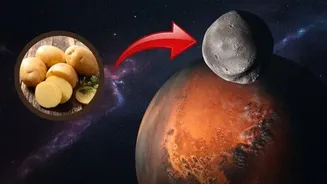
For decades, scientists have debated the origins of Mars's two small moons, Phobos and Deimos. Are they former asteroids captured by Mars's gravity, or are they remnants of a colossal impact on Mars itself billions of years ago? Each theory has profound implications. If Phobos is a captured asteroid, its composition could tell us about the building blocks of the outer solar system, including how water and organic materials were transported. If it was born from Mars, its rocks would hold a geological record of the Red Planet's ancient past. By directly analysing a sample, MMX aims to solve this long-standing puzzle.
The Complex Task of a Cosmic Heist
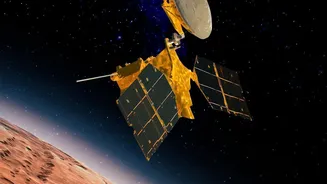
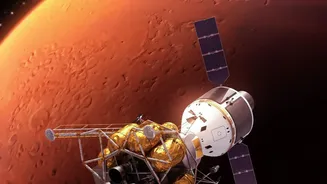
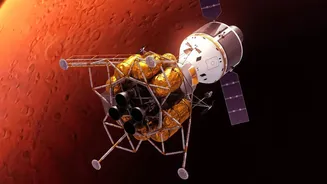
MMX's journey is long and complex. The spacecraft will take approximately one year to reach the Martian system, with an expected arrival in 2027. Once there, it won't immediately land. Instead, it will spend significant time orbiting and studying both Phobos and Deimos to map their surfaces and identify the best possible landing site. The plan includes deploying a small, 25-kilogram rover named Idefix, a joint German-French contribution, which will land first to survey the terrain. The main spacecraft will then perform at least one landing to collect a minimum of 10 grams of regolith, or surface soil. It will use two different mechanisms: a coring tool to drill about two centimetres deep and a pneumatic system that uses gas to blow loose material into a collection chamber.
A Five-Year Journey Home
Collecting the sample is only half the battle. Landing on Phobos is incredibly challenging due to its extremely low gravity, which is thousands of times weaker than Earth's. After its daring surface operations in 2029 or 2030, the spacecraft will fire its engines to leave Martian orbit and begin the long voyage back to our planet. The return journey will culminate in 2031, when a small sample-return capsule will detach from the main spacecraft, plummet through Earth's atmosphere, and parachute down to a designated landing site in Australia. From there, the precious cargo will be transported to labs in Japan and shared with scientists around the world for analysis.
Why MMX Matters for Humanity
The MMX mission is more than just a technological demonstration; it's a quest for fundamental knowledge about our solar system. The samples from Phobos could hold clues about the formation of planets and the conditions that may have allowed life to emerge on a young Mars. Understanding Phobos could help us better understand Mars's transition from a once-habitab.world with water to the cold, dry planet we see today. Furthermore, the technologies developed for MMX, from autonomous landing on a low-gravity body to long-distance deep-space communication, are crucial steps for future human exploration of Mars and beyond.