




The Mystery of the Missing Minis
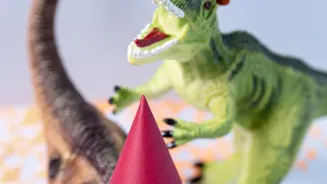
The story of dinosaurs is usually a story of extremes, especially their immense size. But a new study published in the journal Evolution asks a fascinating question: why were there no truly tiny dinosaurs? While some were crow-sized, like Microraptor,
none ever approached the mouse-like or shrew-like sizes that are common in almost every other animal group. For decades, scientists wondered if this was simply a gap in the fossil record. Perhaps the delicate bones of tiny dinosaurs just didn't survive. However, the new research dismisses this idea, pointing out that exquisitely preserved fossils of tiny mammals, lizards, and amphibians are often found in the very same rock layers where tiny dinosaurs are conspicuously absent. This suggests something else was going on; some evolutionary or ecological force was preventing dinosaurs from getting small.
An Ecosystem's Job Market
To understand why, we need to think about an ecosystem like a job market. Every animal has a role, or an 'ecological niche'. This is its profession: what it eats, where it lives, what time of day it is active, and how it avoids being eaten. In the Mesozoic world, there were niches for giant plant-eaters, huge predators, and everything in between. There were also niches for very small creatures that scurried through the undergrowth, hunted insects, and lived in burrows. These roles are incredibly important. Small animals often dominate ecosystems because they require fewer resources and can reproduce quickly. The puzzle was, if this profitable 'tiny creature' job was available, why didn't dinosaurs apply?
Our Nocturnal Ancestors
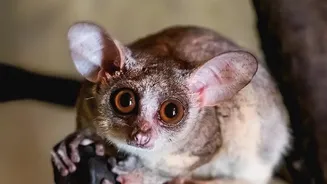
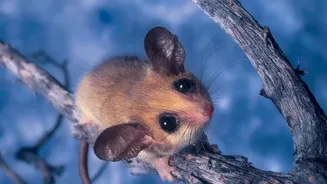
The answer, the new study proposes, lies with our own distant relatives. Throughout the Mesozoic era, early mammals were already on the scene. For about 150 million years, they co-existed with dinosaurs. These were not the diverse mammals we see today; most were small, often shrew-like critters. They were largely nocturnal, hiding from their giant reptilian overlords during the day. Fossils show a range of adaptations, from diggers to gliders, but they all stayed relatively small. It was long thought they lived a marginal existence, simply waiting in the shadows for the dinosaurs to disappear. But the new research suggests they were not just surviving; they were thriving in their own way, and in doing so, they may have cornered a vital market.
The Niche Was Already Taken
The study's central hypothesis turns the old story on its head. Instead of dinosaurs preventing mammals from getting big, it may be that mammals prevented dinosaurs from getting small. The argument is based on competitive exclusion. The shrew-sized mammals had already become highly specialized and efficient at living the life of a tiny, fast-metabolizing creature that eats insects and hides in small spaces. They had effectively filled all the available job openings in the 'small-bodied' category. When any dinosaur lineage tried to evolve in that direction, it would have faced intense competition from mammals who were already experts at the game. According to the researchers, it's likely this pressure from mammals effectively locked dinosaurs out of evolving to the size of a mouse.
A Two-Way Street of Competition
This wasn't a one-sided affair. The same principle applied in the other direction. Just as mammals dominated the undergrowth, dinosaurs dominated everything else. Their sheer size and success in all the medium and large ecological roles created a 'dinosaur ceiling' that prevented mammals from evolving into larger forms. It was a world defined by mutual competition, where each group carved out its territory and, in doing so, limited the evolutionary pathways of the other. Mammals ruled the night and the small niches, while dinosaurs ruled the day and the grander stage. It was a stalemate that lasted for tens of millions of years, until an asteroid dramatically cleared the board and opened up the big-animal niches for the survivors.