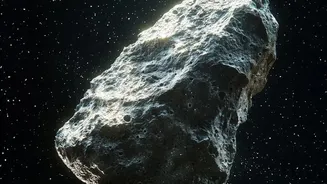




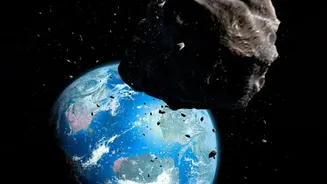
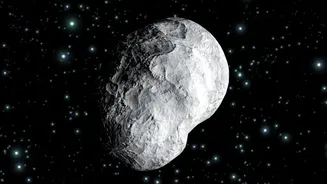
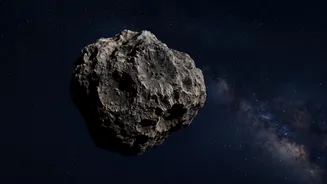
When we picture saving Earth from an asteroid, we imagine a simple, spherical rock. A new study from Sandia National Laboratories shows the reality is far more complex, and our planetary defence strategies must adapt to a lumpy, irregular universe.
Beyond Hollywood Explosions
The
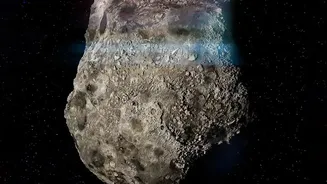
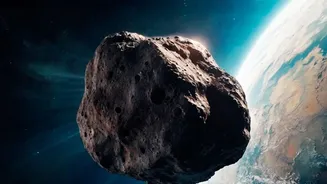
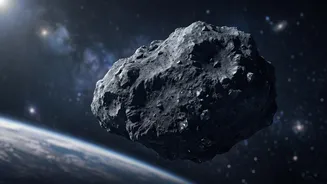
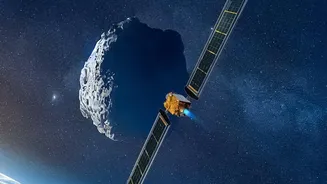
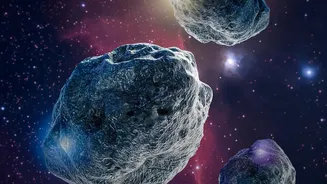
Hollywood blockbuster solution to a threatening asteroid is usually a dramatic, last-minute explosion. In reality, scientists are focused on a more subtle approach: deflection. The goal isn’t to shatter a space rock into countless, still-dangerous pieces, but to give it a gentle nudge years in advance, altering its trajectory just enough to ensure it safely misses Earth. NASA’s successful DART (Double Asteroid Redirection Test) mission in 2022 was a landmark proof of this concept. The spacecraft slammed into the small asteroid Dimorphos, successfully changing its orbit. That mission, however, targeted a relatively known quantity. Planetary defense experts know that to be truly prepared, they must be ready for anything—including asteroids that are far from perfect spheres. Most asteroids are not round; they are lumpy, potato-shaped objects tumbling through space. Until recently, many simulations simplified the problem by modeling them as smooth spheres to make the complex physics calculations manageable.
The Problem with Potato-Shaped Rocks
A new study from physicists at Sandia National Laboratories, published in the journal Icarus, reveals just how much an asteroid's irregular shape matters. Using powerful new computer models, the researchers simulated a specific deflection technique: a standoff nuclear explosion. This method would detonate a nuclear device near an asteroid, not on it. The resulting burst of X-rays would instantly vaporize a thin layer of the asteroid's surface. This vaporized material would shoot off into space, creating a rocket-like thrust that pushes the asteroid in the opposite direction. The Sandia simulations found that the effectiveness of this push depends enormously on where the energy is directed. For the same simulated asteroid, hitting it from one angle produced a deflection velocity nearly five times greater than hitting it from another. For a different simulated object, the change in its spin rate varied by a factor of 17 depending on the blast direction. Physicist Nathan Moore, who led the research, said they expected the aim to matter, but the sheer size of the difference was surprising.
Simulating a Cosmic Nudge
The breakthrough came from a new modeling algorithm that is over 1,600 times faster than previous methods, allowing scientists to combine high-fidelity physics with realistic 3D asteroid shapes for the first time. Past models often forced a choice between accurate shapes or detailed physics calculations; doing both was too computationally expensive. The Sandia team used detailed 3D imagery from past spacecraft flybys of asteroids like Bennu, Itokawa, and Golevka to build their models. The simulations can generate a 'heat map' showing which parts of the lumpy surface vaporize, then calculate the resulting push, spin, and even the potential for surface rocks to break apart. This level of detail is crucial. An effective deflection must be predictable. A push on a flat surface is straightforward, but a push on a ridge or inside a crater can send energy in unexpected directions, potentially leading to an inefficient nudge or an uncontrolled spin. Guessing wrong could mean the difference between successfully deflecting the threat and a very bad day for Earth.
From Theory to a Practical Plan
While kinetic impactors like DART are a proven method, standoff nuclear deflection is considered a vital option, especially if a threatening asteroid is discovered with little warning time. The immense energy from a nuclear device could deflect a larger object or one that needs a more significant course correction than a kinetic impactor can provide. However, the primary goal remains to move the asteroid, not smash it. Breaking a large object into smaller, unpredictable fragments could inadvertently create multiple threats instead of eliminating one. The Sandia study highlights a key limitation in current models: while they can predict surface breakup, they cannot yet reliably determine if the entire asteroid body would fracture under the stress. Closing this knowledge gap is a critical next step for researchers. The study underscores the absolute necessity of getting to know any threatening asteroid up close. Before attempting any deflection, we would need to understand its size, composition, and, most importantly, its exact shape.