



The Cosmic Growth Problem
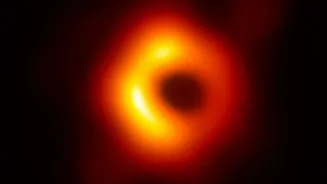
For years, astronomers have been baffled by a cosmic timing issue. Using powerful instruments like the James Webb Space Telescope (JWST), they have spotted quasars—extremely bright objects powered by supermassive black holes—that existed when the universe
was less than a billion years old. These ancient behemoths are millions or even billions of times more massive than our sun. According to our standard understanding, it should take much longer for a black hole to consume enough gas and dust to reach such a colossal size. This has led to a major question: were the 'seeds' of these black holes much larger than we thought, or did they grow in a way we haven't accounted for?
A Flicker in the Dark
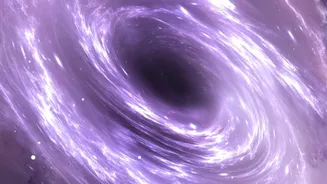
The latest breakthrough comes from a team led by MIT astrophysicists, including Anna-Christina Eilers. By observing a quasar from just 850 million years after the Big Bang, they detected something for the first time at such a great distance: it was flickering. This 'flicker' is caused by fluctuations in the way gas is fed into the black hole. By analysing the patterns of this flickering light, the team could deduce the structure of the material swirling around the black hole in what's known as an accretion disk. To their surprise, the disk looked remarkably mature and stable—a flat, pancake-like structure similar to those seen in the modern universe. This was unexpected, as early black holes were theorised to have more chaotic, puffy, and unsettled accretion disks.
Feast or Famine Growth
This discovery suggests that the story of black hole growth isn't a simple, steady feast. Instead of continuously gobbling up matter, these early giants may have grown in fits and starts. The MIT team's work, along with other recent findings, points to a more episodic or intermittent model. This means a black hole might go through a very rapid, messy growth phase that happens extremely early and quickly, before settling into the more stable, luminous quasar phase that we can observe. This aligns with other research from MIT suggesting that the timescales on which quasars are active are much shorter than previously believed, lasting perhaps only a million years or less instead of a billion. This 'on-again, off-again' activity could help explain how they achieved such massive sizes without needing a continuous, impossibly high-speed diet.
Rewriting Cosmic History
The implications of this are profound. It suggests that the fundamental physics of how black holes feed have been in place since very early in cosmic history. The observation of a mature, thin accretion disk so early on challenges the idea that early black holes were fundamentally different from their modern counterparts. It forces scientists to reconsider the very first stages of black hole formation. Perhaps the initial 'seeds' were more massive, or perhaps their growth was accelerated through other means, like mergers with other black holes—a process also being investigated with JWST data. The work led by Eilers and her colleagues provides crucial, direct evidence that the processes we see today were already active at the dawn of the universe.