



The Universe’s Coldest Laboratories
Across our galaxy lie vast, seemingly empty regions known as giant molecular clouds. These are enormous interstellar nurseries, sprawling clouds of extremely cold gas and dust where new stars and planets are born. With temperatures hovering just a few
degrees above absolute zero, these clouds are far from empty voids. Instead, they are surprisingly active chemical factories, operating under conditions so extreme they make Antarctica seem tropical. For decades, scientists have known these clouds contain simple molecules, but the prevailing view was that more complex chemistry—the kind needed for life—required the warmer, more dynamic environment of a young planet. Recent findings, however, are turning that idea on its head, revealing these frigid clouds as crucibles for prebiotic creation.
A Sweet Discovery in Deep Space
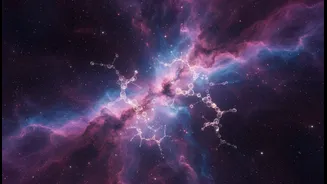
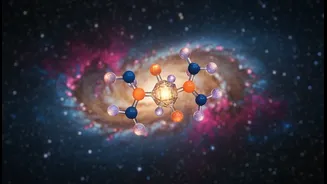
In a remarkable breakthrough, an international team of astronomers recently detected a true sugar molecule, called erythrulose, floating in a molecular cloud near the heart of the Milky Way. Using powerful radio telescopes, they identified the chemical signature of this four-carbon sugar in a cloud named G+0.693−0.027, located about 27,000 light-years from Earth. While molecules related to sugars and other prebiotic compounds have been found in meteorites that have landed on Earth, this is the first time a true sugar has been directly detected in the vast space between stars. Erythrulose belongs to the same family of compounds as ribose, the sugar that forms the backbone of RNA, a crucial molecule for all known life.
Rewriting the Chemical Cookbook
This discovery does more than just add a new molecule to the cosmic inventory; it challenges long-held theories about how complex molecules form in space. Scientists had largely assumed that interstellar chemistry was a slow, step-by-step process, with molecules growing by adding one carbon atom at a time. If that were the case, they would have expected to find simpler, three-carbon sugars in abundance. Instead, they found the more complex four-carbon erythrulose, and lots of it, with no sign of the smaller sugars. The leading hypothesis is that erythrulose forms when two-carbon molecules combine on the icy surfaces of dust grains. This suggests that interstellar chemistry can take larger, more efficient leaps, building sophisticated ingredients more quickly than previously thought.
From Stardust to Life's Recipe
So, how does a sugar molecule formed in a distant, frozen cloud contribute to life on a planet like Earth? The journey is a long one. These molecular clouds are the raw material from which new solar systems are built. As the cloud collapses under its own gravity to form a star, the surrounding dust and ice, now enriched with complex organic molecules like erythrulose, flatten into a disc. This material clumps together to form asteroids and comets. For billions of years, these cosmic delivery vehicles have rained down on young planets, seeding them with water and a rich cocktail of organic compounds. The discovery of sugar in a pre-stellar cloud provides strong evidence that the key ingredients for life didn't have to be made on Earth; they could have been delivered ready-made from space.
A Universe Ripe for Life?
The detection of erythrulose is part of a growing body of evidence showing that the raw materials for biology are common throughout the cosmos. In recent years, astronomers have found other complex organic molecules, including precursors to amino acids and sulfur-based compounds, in similar environments. Even the James Webb Space Telescope has found complex molecules around very young stars, suggesting these ingredients survive the chaotic process of star and planet formation. If the building blocks of life—sugars, amino acids, and the components of DNA and RNA—are being manufactured in interstellar space before planets even form, it dramatically increases the odds that life could be widespread. The universe may be consistently stocking the shelves of new worlds with the fundamental recipe for biology.