



A River of Light
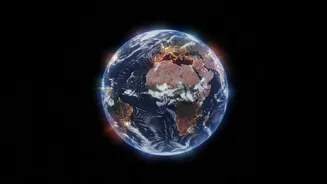
Imagine the world reduced to a single, abstract painting. From 250 miles up, moving at 17,500 miles per hour, cities no longer have names. They blend into vast, interconnected networks of light. Long-exposure photographs, a specialty of astronauts like
Don Pettit, transform these sprawling grids into something fluid and magical. A 30-second exposure can smudge the hard edges of continents, turning the Nile River Delta or the coast of Italy into a golden, glowing web. The Earth, in these images, is not a solid rock but a 'cosmic puddle'—a shimmering, delicate concentration of human life against the infinite black of space. These compositions are a collaboration between human ingenuity and orbital mechanics, a dance between the artist's eye and the planet's relentless motion.
The Artist in the Spacesuit
The modern astronaut is more than a scientist or pilot; they are becoming our generation's most important storytellers. Their mission is not just to conduct experiments, but to translate the profound experience of space for the billions of us left on the ground. Astronauts like Don Pettit, a chemical engineer, have become renowned for their photography, using spare parts to build camera trackers for clearer night shots. Others, like Nicole Stott, became the first person to paint in space with watercolors, trying to capture the vividness that even a high-resolution camera can miss. Even simple acts, like Kimiya Yui doodling constellations onto his star photos, show a deeply human need to connect and create. This isn't a formal part of the job description, but a vital part of the human mission—to share the wonder.
The Challenge of Zero-G Art
Creating these images is a significant technical challenge. Taking a clear photo from the ISS is notoriously difficult. With an exposure of just 1/1000th of a second, the station moves over 20 feet, introducing blur. Night photography requires much longer exposures, compounding the problem. To get these sharp, stunning shots of city lights, astronauts have to manually pan their cameras to compensate for the station's velocity. Pettit famously built a 'barn-door tracker' from spare parts to improve his long-exposure shots of Earth. Even painting has its quirks; Stott had to devise a method to use watercolors without the droplets floating away. Every beautiful image that reaches us from orbit is the result of not just artistic vision, but serious scientific and engineering creativity.
The 'Overview Effect' in a Frame
Why do these images resonate so deeply? Because they are visual manifestations of the 'Overview Effect'—a cognitive shift reported by astronauts who witness Earth from space. From orbit, national borders, political disputes, and religious lines all vanish. All that remains is a single, beautiful, and fragile planet, protected by a paper-thin layer of atmosphere. Astronauts often report an overwhelming sense of connection to humanity and a powerful desire to protect our shared home. Their photography is an attempt to communicate this incommunicable feeling. The 'cosmic puddle of light' is more than a pretty picture; it's a visual metaphor for our collective existence. It shows us as a unified, glowing entity, a testament to our shared presence in the vast emptiness, prompting a change in perspective for those who see it.