




Meet the Roman Space Telescope
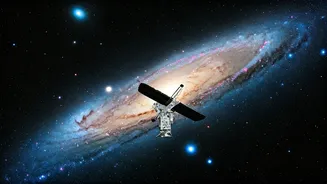
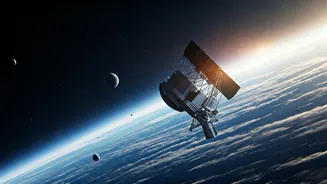
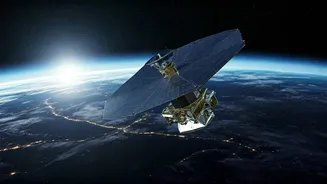
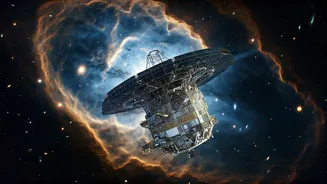
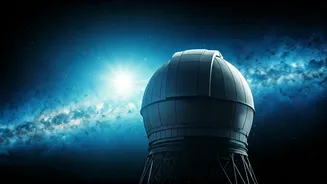
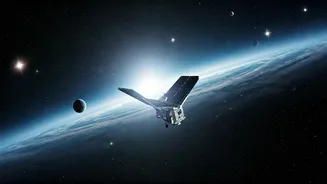
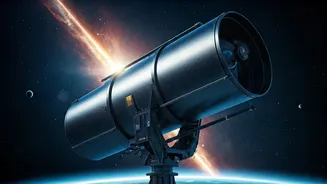
Set for launch on August 30, 2026, NASA’s Nancy Grace Roman Space Telescope is a next-generation observatory designed to tackle some of the biggest questions in cosmology. Named after Dr. Nancy Grace Roman, NASA's first Chief of Astronomy and the “Mother
of Hubble,” this telescope has a 2.4-meter primary mirror, the same size as Hubble's. However, its revolutionary Wide Field Instrument gives it a field of view 100 to 200 times larger than Hubble's infrared camera. This panoramic perspective will allow Roman to map the sky at an unprecedented speed, gathering more data in a single year than Hubble has in over three decades.
The Universe's Biggest Mystery
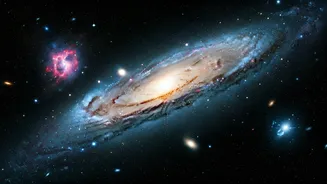
The "dark side" of the universe isn't a place, but rather two of its most dominant ingredients. Together, dark matter and dark energy are thought to constitute about 95% of the cosmos, with the ordinary matter that makes up stars, planets, and people accounting for a mere 5%. Dark matter is the invisible "cosmic cement" that provides the extra gravitational pull needed to hold galaxies together; without it, they would fly apart. Dark energy, on the other hand, is a repulsive force that acts like anti-gravity, pushing the universe apart and causing its expansion to accelerate. They are called "dark" simply because they do not absorb, reflect, or emit any light, making them impossible to see directly.
A Cosmic Detective's Toolkit
So how does a telescope search for something that is invisible? Roman will act as a cosmic detective, looking for the tell-tale clues these dark components leave behind. To hunt for dark matter, the telescope will use a technique called gravitational lensing. Massive objects, including large clumps of dark matter, warp the fabric of spacetime, causing light from distant galaxies to bend as it passes by. By precisely measuring these tiny distortions in the shapes of millions of galaxies, Roman can create a map of where the invisible dark matter is located. To investigate dark energy, the telescope will measure the distances to faraway galaxies and stellar explosions called supernovae with extreme accuracy. Tracking how the distances between galaxies have changed over cosmic history will reveal how the universe's expansion has accelerated over time, providing crucial insights into the nature of dark energy.
More Than Just the Dark Side
While unraveling the secrets of dark matter and dark energy is its primary mission, the Roman Space Telescope is a multi-talented observatory. Its vast surveys are expected to discover thousands of exoplanets—planets orbiting other stars. Using a technique called gravitational microlensing, Roman will be sensitive enough to find planets with masses as small as Mars, and even free-floating planets that don't orbit a star at all. The telescope will also be equipped with a Coronagraph Instrument, a technology demonstrator designed to block the overwhelming glare from a star to directly image the planets orbiting it. This capability is a crucial stepping stone for future missions that will search for signs of life in the atmospheres of Earth-like worlds.
Why This Mission Matters
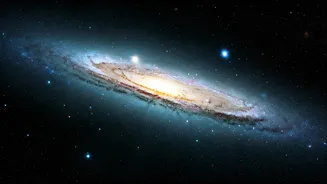
The Roman Space Telescope's quest is about more than just cataloging the cosmos; it's about understanding our fundamental place within it. The discoveries it makes could rewrite our understanding of gravity, the evolution of the universe, and its ultimate fate. Learning about the properties of dark energy will help determine whether the universe will continue expanding forever or end in some other fashion. Mapping the cosmic web of dark matter will reveal the invisible scaffolding upon which all visible structures, including our own Milky Way galaxy, were built. By providing a panoramic, high-resolution view of the universe, Roman will arm scientists with a massive trove of data to answer questions we have today and to ask new ones we haven't yet imagined.