



A 50-Year Cosmic Mystery
Imagine a detective story that takes half a century to solve. That's exactly what has been unfolding at the centre of our own Milky Way galaxy. For decades, scientific theory predicted that Sagittarius A, the supermassive black hole lurking 26,000 light-years
from Earth, shouldn't just be a silent void. Like all black holes that feed on surrounding gas and dust, it was expected to produce an enormous outflow, a kind of powerful 'wind' pushing material back out into space. This concept is fundamental to our understanding of how galaxies evolve. Yet, despite increasingly powerful telescopes and countless hours of observation, this predicted wind remained frustratingly invisible, creating a major puzzle for astrophysicists.
What Is a Black Hole Wind?
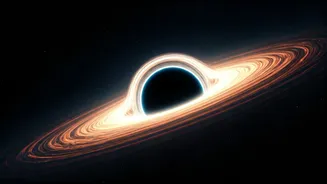
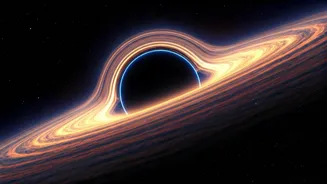
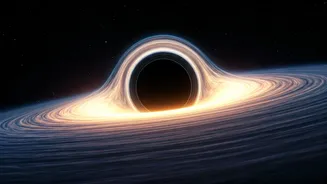
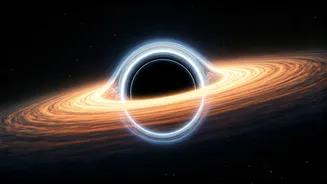
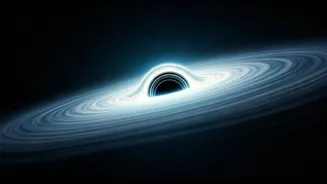
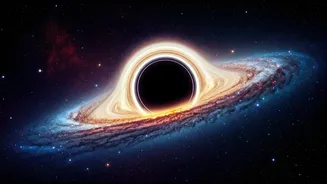
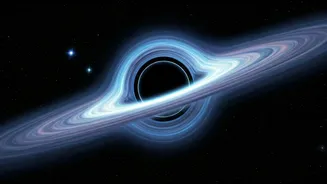
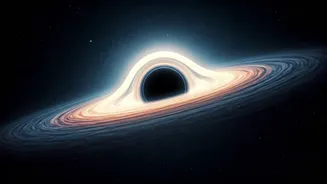
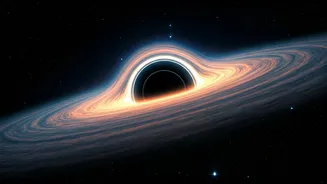
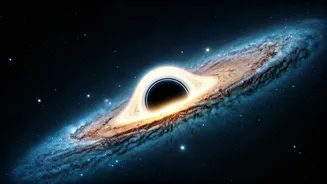
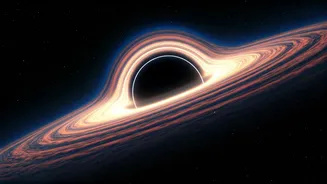
Unlike the wind we feel on Earth, a black hole wind is a stream of superheated gas and particles blown away from the black hole's immediate vicinity. It’s a messy process; as matter gets pulled toward a black hole, it forms a chaotic, swirling disc. The immense gravity, friction, and magnetic forces within this disc heat the material to incredible temperatures, generating enough energy to launch a portion of it back into the galaxy at tremendous speeds. These outflows are cosmic engines that regulate the growth of the black hole and influence the formation of new stars across the galaxy. Without finding one at our own galactic centre, it made our Milky Way seem like a strange exception to the rule. The question was, were the theories wrong, or were we just not looking in the right way?
A Breakthrough Observation
The answer finally came thanks to the Atacama Large Millimeter/Submillimeter Array (ALMA), a collection of powerful radio telescopes in Chile. A team of researchers from Northwestern University spent years compiling deep observations to create the sharpest-ever map of the cold molecular gas swirling near Sagittarius A. After carefully processing the data, they were gobsmacked by what they saw: a giant, cone-shaped cavity carved out of the gas. This void, stretching about three light-years in length, was the smoking gun. It was a clear imprint left by something powerful pushing the cold gas aside or heating it up until it was no longer visible. That something, the team concluded, could only be the long-sought wind from the black hole.
Hiding in Plain Sight
So why did it take 50 years to find this massive feature? The centre of the Milky Way is one of the most challenging regions of the sky to observe. We have to peer through thick clouds of gas, dust, and stars that obscure our view. Furthermore, Sagittarius A is a relatively gentle giant compared to the voracious supermassive black holes found in other galaxies. Its 'wind' is more of a subtle breeze than a raging gale, making its signature much harder to detect. It took the incredible sensitivity of ALMA and a painstaking analysis of years of data to finally filter out the noise and see the clear evidence that had been hiding in plain sight all along.
More Than Just a Void
Confirming the existence of this wind does more than just tick a box on a theoretical checklist. It proves that our galaxy's central black hole is an active and dynamic engine that shapes its environment. This finding helps connect the dots between other extreme phenomena observed at the galactic core. For years, scientists have also seen evidence that the area acts as a colossal particle accelerator, dubbed a 'PeVatron,' which flings out cosmic rays — particles moving at nearly the speed of light. The energy needed to power such an accelerator has been a mystery, but the confirmation of an active wind from Sagittarius A makes the black hole itself the most plausible source for these extreme energies. The discovery of the wind provides a crucial piece of the puzzle, tying the black hole directly to the violent processes that make the galactic centre the most energetic neighbourhood in the Milky Way.