
A New Cosmic Mystery
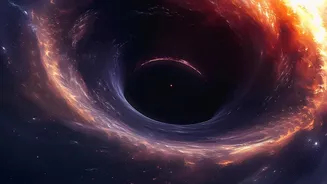
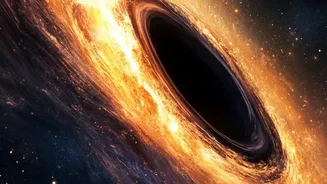
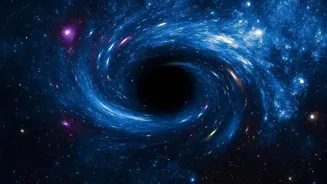
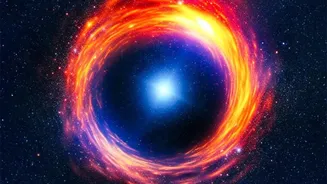
Astronomers have spotted an object, named MoM-BH-1, that existed just a few hundred million years after the Big Bang. While it's the size of our solar system, it glows with the energy of 100 billion suns, far brighter than any normal star could be. This
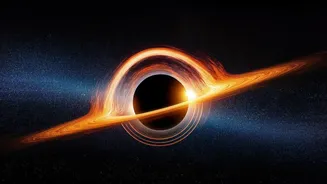
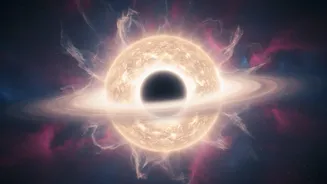
immense energy output is more typical of a black hole. This unusual combination of star-like size and black-hole-like power led researchers to propose it's an entirely new kind of object: a black hole star, a type of 'quasi-star' that has been theorized but never seen until now.
What Is a Black Hole Star?
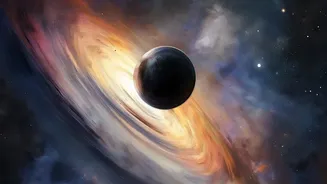
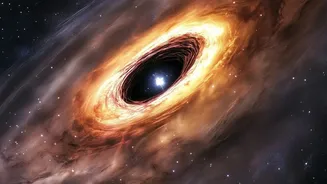
Unlike the stars we know, which are powered by nuclear fusion in their cores, a quasi-star or black hole star gets its energy from a central black hole. The theory, first proposed in 2006, suggests that in the early universe, a massive cloud of primordial gas could collapse to form a black hole at its center. However, instead of the resulting explosion blowing everything away, the immense outer layers of gas would remain intact, forming a star-like cocoon around the black hole. The star would then be 'powered' by the incredible energy released as this gas envelope continuously falls into the central black hole, creating a stable, albeit temporary, cosmic giant.
Solving the Puzzle of the 'Little Red Dots'
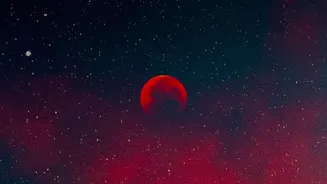
Since it began operations, the James Webb Space Telescope (JWST) has been finding numerous 'little red dots' scattered across its images of the early universe. The identity of these objects has been a major puzzle for astronomers. If MoM-BH-1 is confirmed to be a black hole star, it could be the key to understanding these other mysterious dots. Researchers suggest that these dots may be other, less-bright examples of black hole stars, providing a whole new class of objects to study from the universe's dawn.
Rewriting the History of Supermassive Black Holes
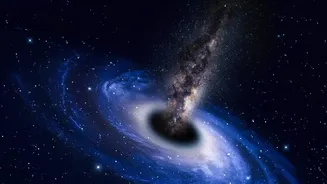
One of the biggest questions in cosmology is how supermassive black holes, which sit at the center of most galaxies, grew so large so quickly in the early universe. Current models struggle to explain their rapid formation. The discovery of black hole stars offers a compelling new pathway. According to theory, these objects would have a short lifespan of a few million years, during which the central black hole would rapidly accrete mass from its gaseous envelope. When the star finally dissipates, it would leave behind an intermediate-mass black hole, the perfect 'seed' to grow into the supermassive black holes we observe today. This could solve the mystery of their unexpectedly early appearance.
What Comes Next?
The identification of MoM-BH*-1 as a black hole star is still a 'possible' discovery, with researchers stating that it is the 'most likely explanation' based on current models and observations. While the data from JWST is compelling, more observations and analyses are needed for confirmation. The light signatures don't perfectly align with what would be expected from a dusty object, strengthening the black hole star hypothesis. Scientists will continue to study this object and search for other bright candidates among the little red dots. If confirmed, this finding doesn't just add a new object to the cosmic catalogue; it opens a direct window into the formation of the universe's first giants and the birth of the galaxies we see today.