


Cosmic Misfits Explained
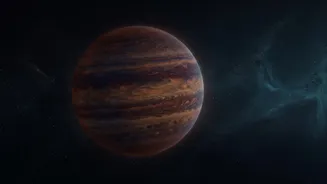
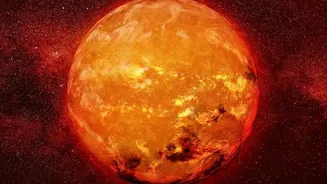
Imagine an object that forms from a collapsing cloud of gas and dust, just like a star, but never quite makes it to the big leagues. That, in essence, is a brown dwarf. These celestial bodies are often called 'failed stars' because while they accumulate
enough mass to be many times larger than Jupiter, they fall short of the roughly 75-to-80-Jupiter-mass threshold needed to ignite sustained hydrogen fusion in their cores, the process that makes stars shine. They are more massive than planets but lighter than stars, occupying a fascinating grey area. Instead of generating light and heat through fusion, they glow dimly from the residual heat of their formation, slowly cooling and fading over billions of years. This makes them incredibly difficult to detect, like cosmic embers drifting through the dark.
A New Census of the Cosmos
For decades, only a few dozen brown dwarfs could be studied in detail, leaving much about them shrouded in mystery. However, NASA's SPHEREx telescope is changing the game. Short for Spectro-Photometer for the History of the Universe, Epoch of Reionization, and Ices Explorer, this powerful new instrument is conducting a massive sky survey. In doing so, it is in the process of imaging and analyzing thousands of these dim wanderers, dramatically increasing our sample size. This leap in quantity allows scientists to move from studying individual curiosities to understanding the entire population, providing a much clearer picture of their diversity, distribution, and evolution. These free-floating objects are now being seen as a key component of our galaxy's makeup, with untold numbers roaming the cosmos alone.
An Atmosphere of Surprises
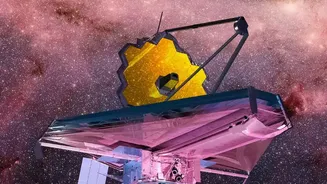
The latest research isn't just about finding more brown dwarfs; it's about understanding what they're made of. By analyzing the light that passes through their atmospheres, telescopes like SPHEREx and the James Webb Space Telescope (JWST) can identify the chemical molecules present. Recent findings from SPHEREx show that their atmospheres are chemically rich, containing familiar molecules like methane, carbon dioxide, and carbon monoxide. But JWST has uncovered even stranger details. On one cold brown dwarf named W1935, astronomers were stunned to find methane that was glowing, or in emission, rather than absorbing light as expected. The team speculates this could be caused by powerful aurorae, similar to the Northern Lights on Earth, a process never before seen on such an isolated object.
Blurring the Planet-Star Line
These new discoveries are forcing astronomers to rethink the very definitions of 'star' and 'planet'. Using the unparalleled sensitivity of JWST, researchers have identified free-floating brown dwarfs with masses of only three to four times that of Jupiter. These objects are so small that they challenge current theories of how stars form, as it's difficult to explain how such a tiny object could collapse under its own gravity. Adding to the complexity, astronomers found an unidentified hydrocarbon signature in the atmospheres of these tiny worlds, a molecule not predicted by existing models. In another case, JWST observed a young brown dwarf that was surrounded by a disk rich in hydrocarbons, the building blocks for planets. This raises the tantalizing possibility that planets could form around an object that is itself not much bigger than a giant planet.
Why These Failed Stars Matter
Studying these cosmic 'in-betweeners' does more than just fill a gap in our celestial catalog. It provides a crucial window into the fundamental processes of the universe. By probing the lower mass limits of star formation, brown dwarfs help us refine our models of how all stars, including our own sun, come to be. Their atmospheres serve as natural laboratories for exotic chemistry, offering insights that are directly applicable to the study of gas giant exoplanets orbiting other stars. By understanding the molecules, cloud structures, and atmospheric dynamics of these relatively nearby objects, scientists can better interpret the data from distant worlds, including the ongoing search for habitable planets. Each discovery about a brown dwarf adds another piece to the puzzle of how planetary systems form and evolve.