







A Planet's Unprecedented Fever
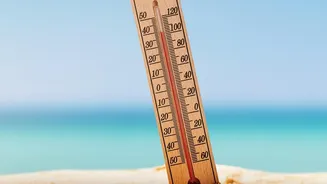
On August 22, 2026, the daily global average sea surface temperature, excluding polar regions, hit 21.1 degrees Celsius. This narrowly surpassed the previous record set in March 2024. While a fraction of a degree may not sound like much, scientists emphasize
that due to the immense volume of the world's oceans, even small temperature increases represent a colossal absorption of heat energy. The timing of this new record is particularly alarming. Typically, oceans are at their warmest in March, following the Southern Hemisphere's summer. Setting a new global heat record in August signals a significant and worrying anomaly in the planet's climate system. This isn't an isolated spike; it's part of a relentless trend that has seen the last four years become the hottest on record for ocean surface temperatures.
The Twin Engines of Record Heat
This dangerous milestone is being driven by a powerful combination of factors. The primary driver is the long-term, human-caused warming of the planet. For decades, the oceans have acted as the Earth's primary heat sink, absorbing over 90% of the excess heat trapped by greenhouse gas emissions. This has created a baseline of persistently warmer water. Layered on top of this is a strong, developing El Niño event in the Pacific Ocean. El Niño is a natural climate pattern characterized by warmer-than-average sea surface temperatures in the tropical Pacific. While natural, its effects are now being amplified by the already-warmed state of the oceans, creating a compounding effect that pushes global temperatures into uncharted territory. Scientists also point to the influence of other climate cycles, like the Indian Ocean Dipole, which can further affect temperatures and rainfall patterns.
From a Warm Ocean to Wild Weather in India
For India, with its extensive coastline along the Arabian Sea and the Bay of Bengal, these warming oceans are not a distant problem. Warmer seas provide more fuel for weather systems, supercharging their intensity. Scientists have already linked rising sea temperatures to the rapid intensification of cyclones in the region. Furthermore, this oceanic heat disrupts atmospheric circulation, leading to more erratic and extreme rainfall. Studies suggest that excessive warming in the western Indian Ocean can cause monsoon winds to release moisture over the sea instead of carrying it inland, potentially creating drought-like conditions in some parts of India while simultaneously causing severe flooding in others. The Indian National Centre for Ocean Information Services (INCOIS) has reported significant marine heatwave conditions across the Arabian Sea, creating a zone of thermal stress that directly impacts India's weather.
An Underwater Crisis for Livelihoods
The consequences of this record heat extend deep beneath the waves, threatening marine ecosystems and the millions of people who depend on them. The number of marine heatwave days globally has more than tripled since the early 1990s. These prolonged periods of extreme warmth can be devastating for marine life. Coral reefs, which are vital habitats for roughly 25% of all marine species, are particularly vulnerable. Sustained high temperatures cause coral bleaching, a stress response that can lead to mass die-offs, threatening fisheries and the coastal protection reefs provide. This also leads to a rise in toxic algal blooms, which can cause mass deaths of fish and other marine animals. For India's coastal communities, this translates into a direct threat to food security and the economic stability of the fishing industry.
What Comes After a Broken Record?
Breaking a temperature record is a stark headline, but for scientists, the more critical issue is the trend. The oceans are not just warmer; they are warming at an accelerated rate, with the pace nearly doubling in the last two decades. A warmer ocean is also a less efficient one. As temperatures rise, the ocean's ability to absorb carbon dioxide from the atmosphere diminishes, weakening one of the planet's most important natural buffers against climate change. Furthermore, the heat causes water to expand, a phenomenon known as thermal expansion, which contributes directly to sea-level rise and increases the risk of coastal flooding. With the current El Niño expected to strengthen further, scientists anticipate that more temperature records could fall in the coming months, pushing our planet further into what many are calling uncharted territory.