




The Red Planet has a new set of weather watchers. In a remarkable display of global scientific collaboration, Indian scientists are at the forefront of decoding Mars's complex climate, using data from an entirely different nation's spacecraft.
A Global Effort to Understand a Distant World
The key
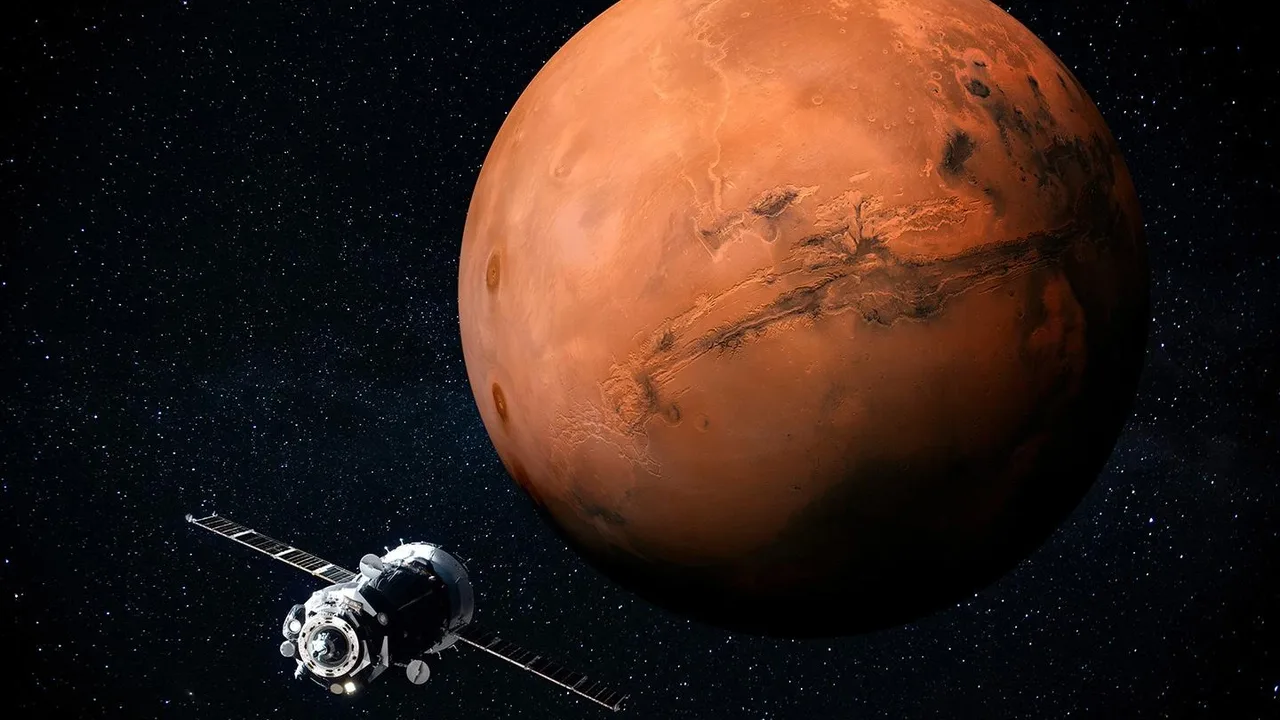
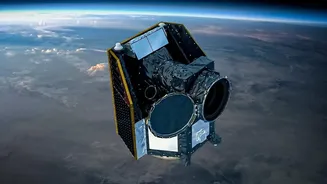
to this new research lies with the Emirates Mars Mission, also known as the 'Hope' probe, a landmark project by the United Arab Emirates. Launched in 2020, the probe is the first interplanetary mission from the Arab world. One of its key instruments is the Emirates Mars InfraRed Spectrometer, or EMIRS. Think of EMIRS as a highly advanced thermal camera, designed to measure the temperature of Mars's surface and atmosphere. It tracks the global distribution of dust, water ice clouds, and water vapor, providing a comprehensive picture of the Martian climate system. The UAE made the ground-breaking decision to make all data from the Hope probe publicly available to the international scientific community, fostering a new era of collaborative space science.
Ahmedabad's Window into Mars
Answering this open invitation, a team of scientists from the Physical Research Laboratory (PRL) in Ahmedabad has been diligently analysing the treasure trove of data from EMIRS. PRL, an autonomous unit of India's Department of Space, has a long and storied history of planetary science, having played a pivotal role in India's own successful Mars Orbiter Mission, Mangalyaan. This new research, published in the journal Current Science, showcases how Indian scientific expertise is being applied to fresh datasets, continuing the nation's legacy in Martian exploration even without an active craft in orbit currently.
The Planet of Extremes
So, what have the PRL scientists found? Their work paints a vivid picture of a planet with a wild and dynamic climate. The study focused on two massive impact basins, Hellas and Argyre, and confirmed staggering temperature fluctuations. During the southern summer, surface temperatures can be a surprisingly mild 27 degrees Celsius, only to plummet to a bone-chilling minus 113 degrees Celsius in winter. These extreme swings are largely due to Mars's incredibly thin atmosphere—about 100 times thinner than Earth's—which cannot effectively trap and distribute heat. The planet warms up quickly in the sun and loses that heat just as fast when it sets. Mars's highly elliptical orbit also means its seasons are far more imbalanced than ours, creating intense summers in the southern hemisphere.
Decoding the Martian 'Breath'
Beyond just temperature, the research has mapped large-scale atmospheric patterns called zonal waves. These waves ripple through the thin Martian air, providing clues about the planet's atmospheric circulation—much like watching ripples on a pond tells you about unseen currents. The PRL team found that the planet's dramatic topography, especially deep basins and giant volcanoes, plays a huge role in shaping these weather patterns. By comparing the EMIRS data with existing climate models, the scientists found that while the models predicted the general patterns, the actual measured temperatures were often warmer, highlighting the need for these real-world observations to refine our understanding. This detailed mapping of Mars's climate is not just an academic exercise; it's crucial for planning future robotic and, eventually, crewed missions to the Red Planet.