






The Global Crisis of Coral Bleaching
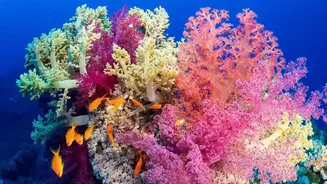
Coral reefs are often called the 'rainforests of the sea', and for good reason. They support about a quarter of all marine life, protect coastlines from storms and erosion, and sustain economies through tourism and fishing. But these vibrant underwater
cities are facing a catastrophic threat: climate change. As ocean temperatures rise, corals become stressed and expel the symbiotic algae living in their tissues. These algae, known as zooxanthellae, are the coral's primary source of food and are responsible for their brilliant colours. When they are expelled, the coral turns bone-white, a phenomenon known as bleaching. A bleached coral is not dead, but it is starving and vulnerable. If temperatures don't return to normal, many will not survive, and recovery can take months or even years.
A 'Shocking' Discovery in the Lab
Scientists at Stanford University have now witnessed the fastest coral recovery ever documented. A study published in October 2026 revealed that severely bleached corals can be brought back to full health in as little as seven weeks. The method is surprisingly simple: placing the dying coral in direct physical contact with a healthy, genetically identical clone. The discovery happened partly by accident in 2025, when a researcher noticed colour returning to a bleached coral fragment that had tipped over and touched its healthy twin in a lab tank. Lead author Danny Collins, a PhD student at the Stanford Doerr School of Sustainability, was stunned by the results of a follow-up experiment. 'We were blown away [to] actually watch the healthy coral restore the color of the bleached corals essentially right before our eyes', he said.
How a Simple Touch Revives a Coral
The secret lies in the unique biology of corals. Many corals grow by creating clones, forming vast colonies of genetically identical individuals. When two of these clones touch, they recognise each other. Instead of fighting, their tissues fuse together, creating a bridge. Through this fused tissue, the healthy coral acts like a lifeline, transferring life-giving algae and nutrients to its struggling partner. Researchers observed that this 'inoculation' kick-starts the recovery process in as little as three days. The algae then begin to multiply within the bleached coral at a rate roughly 10 times faster than what is typically seen in the wild, allowing for the rapid seven-week recovery. The team even found that continuous contact wasn't necessary; a brief touch for as little as five to seven days was enough to give the bleached coral the resources it needed to recover on its own.
From the Lab to the Great Barrier Reef?
This discovery provides a powerful new insight into coral resilience, but it is not a silver bullet for the world's reefs. The study was conducted in a controlled lab setting, and the method requires having a healthy, genetically identical clone for every bleached coral, which is not practical on a large scale. If corals from different genetic backgrounds touch, they will fight each other rather than fuse. However, the study's key finding is that bleached corals have a 'remarkable capacity for rapid recovery' that was previously unappreciated. It proves that if healthy algae can be delivered to a starving coral, it can bounce back with incredible speed. This opens the door for new restoration strategies that don't rely on direct tissue fusion.
The Future of Reef Restoration
Researchers are now exploring how to turn this discovery into a scalable solution. The challenge is to find ways to extract beneficial algae, replicate them in a lab, and then deliver them to wild corals without needing a genetic twin for each one. Ideas being explored include developing bio_engineered 'probiotic' solutions that could be sprayed over bleached reefs. This Stanford study joins a growing field of research focused on creating 'super_corals' that are more resilient to heat stress. While these interventions are promising and necessary, scientists caution that they are tools to buy time. They cannot replace the most critical action of all: addressing climate change and lowering ocean temperatures. Without that, even the most innovative restoration efforts will be fighting a losing battle against an ever_warming sea.