






Reading the Galactic Fossil Record
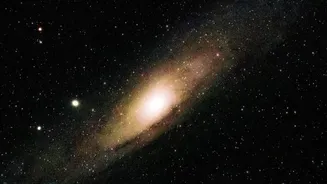
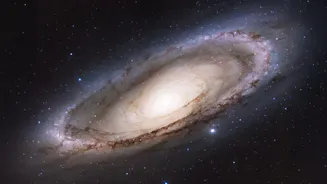
Just 2.5 million light-years away, the Andromeda galaxy (M31) is the closest major spiral galaxy to our own Milky Way. Its proximity makes it a unique laboratory for understanding how galaxies form and evolve. Because we are inside the Milky Way, we can't
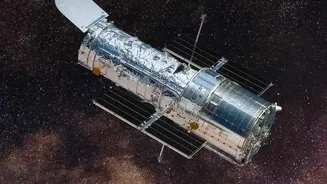
get a bird's-eye view of our own galaxy's structure. Andromeda, however, offers us a complete picture. To decipher its history, astronomers embarked on an ambitious project called the Panchromatic Hubble Andromeda Treasury (PHAT) and its southern counterpart, PHAST. These surveys used the Hubble Space Telescope to create an incredibly detailed map, resolving over 200 million individual stars across two-thirds of the galaxy's sprawling disk. By studying the colour and brightness of these stars—the 'fossil record' of the galaxy—scientists can rewind time and reconstruct Andromeda's life story.
A Tale of Boom and Bust
The study's most profound finding is that Andromeda's star formation has not been a steady process. The galaxy experienced a major 'starburst' about two billion years ago, likely triggered by a merger or interaction with another, smaller galaxy. This event was so intense that it created a significant portion of the stars we see in Andromeda today. However, since that dramatic peak, things have been quieting down. Recent analysis published in The Astrophysical Journal shows a steady decline in star birth over the past 500 million years. This slowdown became even more pronounced in the last 40 million years, indicating that the galaxy is entering a new, quieter phase of its life.
Pinpointing the Slowdown
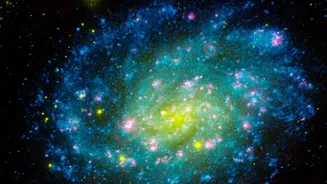
To understand this decline, astronomers measured the rate at which gas and dust are converted into new stars. Five hundred million years ago, Andromeda was creating stars at a rate of about one solar mass (the mass of our Sun) per year, similar to the Milky Way's current rate. By 40 million years ago, that rate had dropped by half. Today, it has plummeted to just one-fifth of a solar mass per year. Much of this recent activity has been concentrated in a prominent ring about 32,000 light-years from the galactic centre. The new research shows that the fading activity within this specific ring is the primary driver of the galaxy-wide decline. It isn't that Andromeda is running out of fuel; rather, it seems to be naturally winding down after its earlier marathon of star creation.
A Likely Galactic Suspect
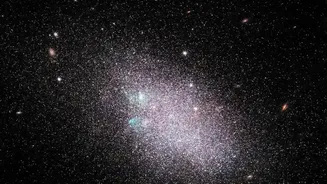
Astronomers also investigated whether interactions with Andromeda's satellite galaxies could be influencing its star birth. One prime suspect is M32, a compact dwarf galaxy. By examining the region of Andromeda closest to M32, scientists found a notable decrease in star formation that began around 60 million years ago. This timeline suggests that M32 may have plunged through Andromeda's disk, disrupting gas clouds and effectively shutting down star creation in its path. While researchers cannot yet say for certain that M32 is the culprit, the evidence points strongly in its direction, providing a fascinating example of how galactic interactions can shape a galaxy's evolution.