





A Galaxy with a Puzzling Tilt
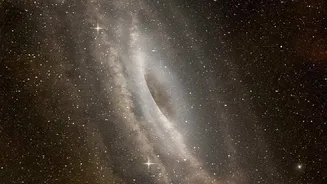
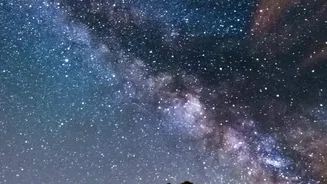
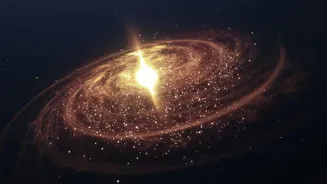
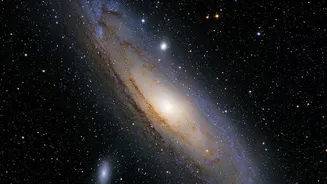
Imagine the Milky Way as a spinning plate. The vast majority of its stars, including our sun, reside in this flat, rotating disc. But surrounding this disc is a vast, sparse sphere of older stars called the stellar halo. For years, astronomers were stumped
by a strange observation: while the stars in the disc zip around the galactic centre at high speed, the stars in the halo barely seem to move, rotating far more slowly. This discrepancy suggested something dramatic happened in our galaxy's youth. Recent findings point to a startling explanation: the entire disc of the Milky Way may have been knocked on its side, flipping more than 90 degrees over hundreds of millions of years. This galactic tilt, or flip, would have been one of the most transformative events in its history.
Meet the 'Gaia Sausage'
The prime suspect behind this cosmic upheaval is a dwarf galaxy that astronomers have playfully nicknamed the 'Gaia Sausage'. This object, also known as Gaia-Enceladus, was no lightweight. It contained stars, gas, and dark matter adding up to more than 10 billion times the mass of our sun. Sometime between 8 and 11 billion years ago, long before our solar system formed, this galaxy smashed head-on into the young Milky Way. The collision was catastrophic for the smaller galaxy, which was torn to shreds. Its stars were scattered and pulled into long, needle-like orbits that plunge close to the Milky Way's core before swinging far out again. When astronomers plotted the velocities of these captured stars using data from the European Space Agency's Gaia satellite, the resulting shape resembled a sausage, giving the ancient galaxy its unusual name.
Simulating a Cosmic Collision
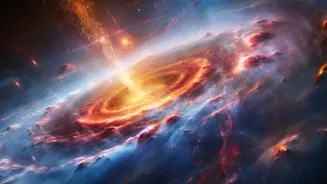
Scientists couldn't witness an event that happened billions of years ago, so they turned to powerful supercomputer simulations to piece together the past. A team from Durham University ran simulations of how galaxies like our own evolve, especially after major collisions. They found a consistent pattern: when a Milky Way-like galaxy experienced a massive, head-on merger similar to the Gaia Sausage event, it often resulted in two key features. First, the gravitational chaos from the merger exerted a powerful torque that caused the galaxy's main disc to gradually flip over. Second, the resulting stellar halo, populated by the debris of the consumed galaxy, ended up rotating very slowly. This simulated outcome perfectly matches the puzzling slow rotation we observe in the Milky Way's halo today, providing strong evidence that our galaxy was indeed flipped by this ancient crash.
Rewriting Our Galactic History
This discovery does more than just solve the riddle of the slow-moving halo; it rewrites our understanding of how the Milky Way was built. The Gaia Sausage merger wasn't a minor fender-bender; it was a defining event that fundamentally reshaped our galactic home. The impact and subsequent merger likely triggered a massive burst of star formation, creating what astronomers call the galaxy's 'thick disc'. The debris from the shattered dwarf galaxy also settled to form the large, star-dense bulge at the Milky Way's centre and contributed a huge portion of the stars in the surrounding halo. This violent history of galactic cannibalism, where large galaxies grow by consuming smaller ones, is now understood to be a key part of cosmic evolution. The very structure of our galaxy is a fossil record of this dramatic past.