





A Lonely Voice in the Void
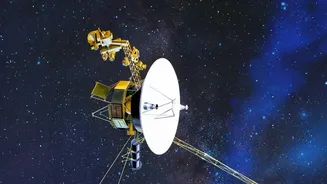
Launched in 1977, NASA's Voyager 1 is a testament to the endurance of exploration. Originally sent to study Jupiter and Saturn, it completed its primary mission in 1980 and has been coasting into the unknown ever since. In 2012, it became the first human-made
object to enter interstellar space, the vast emptiness between the stars. Now, more than 25 billion kilometres from home, it continues to send back invaluable data about this uncharted territory. The twin Voyager probes are powered by radioisotope thermoelectric generators, which convert heat from decaying plutonium into electricity. With this power source fading by about four watts each year, the mission has become a delicate balancing act of conserving energy to keep its remaining instruments alive.
A Crisis Billions of Kilometres Away
In November 2023, the mission faced a dire threat. Voyager 1 began sending back a stream of unintelligible gibberish instead of its usual neat packages of scientific and engineering data. The problem was traced to the Flight Data Subsystem (FDS), one of the probe's three onboard computers, which is responsible for packaging information before it's transmitted to Earth. A single faulty memory chip was corrupting the entire data stream. For mission controllers at NASA's Jet Propulsion Laboratory (JPL), this was a nightmare scenario. Fixing a software bug is one thing; fixing a hardware failure on a 47-year-old computer that is a 45-hour round-trip away by radio signal is another entirely.
Hacking a 47-Year-Old Computer
The engineering team at JPL faced an immense challenge. Most of the original engineers who designed and built the spacecraft have long since retired or passed away. The team had to pore over decades-old documents to understand the archaic programming and intricate systems. They couldn't physically replace the broken chip, so they had to devise a way to work around it. After months of painstaking analysis, they pinpointed the exact location of the corrupted memory. The solution they developed was both audacious and elegant: a long-distance digital bypass operation.
A Game of Digital Shuffle
The plan was to effectively abandon the broken section of memory. Engineers decided to slice up the affected FDS code and store the individual pieces in different, still-functioning locations across the spacecraft's memory banks. This was like realizing a crucial shelf in your library has collapsed and deciding to distribute those books onto various other shelves wherever you can find a few inches of space. The team then had to update all the code to ensure these relocated segments would still work together seamlessly as a whole. In April 2024, after five months of silence, they sent the complex commands. Almost two days later, the reply came: for the first time since the glitch began, Voyager 1 sent back a clear and readable status update.
The Whispers Continue
Following the initial success, the team worked to restore the flow of science data. By June 2024, NASA confirmed that all four of the probe's remaining active science instruments were once again returning usable information. The instruments measure plasma waves, magnetic fields, and particles, providing the only direct sampling of the interstellar medium. While the fix was a resounding success, the mission's life is still finite. To manage the dwindling power supply, NASA is constantly making tough choices, such as shutting down other instruments to prolong the mission. In April 2026, the Low-Energy Charged Particles instrument was powered down to save energy after an unexpected power dip. Still, the ingenious repair of the FDS has given Voyager 1 a new lease on life, allowing its journey of discovery to continue.