

What is an Evening Elongation?
In simple terms, an elongation is the moment when Venus appears farthest from the Sun in our sky. Because Venus’s orbit is inside Earth’s, it never strays far from the Sun’s glare from our perspective. This means we only ever see it for a few hours after
sunset (as an 'Evening Star') or before sunrise (as a 'Morning Star'). On August 15, 2026, Venus reaches its 'greatest eastern elongation'. This is the peak of its evening appearance, when it reaches its maximum angular distance—about 46 degrees—from the Sun. This event provides the best and safest time to observe the planet, as it hangs in the twilight sky long after the Sun has dipped below the horizon.
Our Brilliant Sister Planet
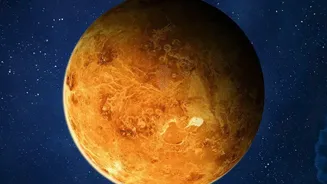
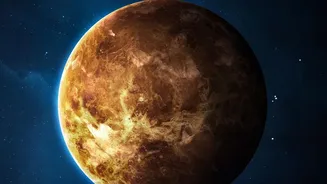
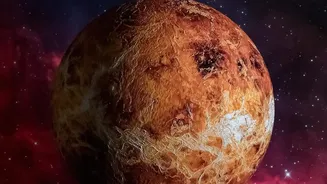
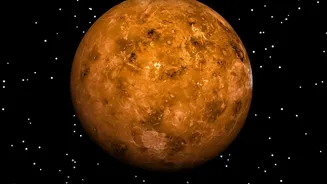
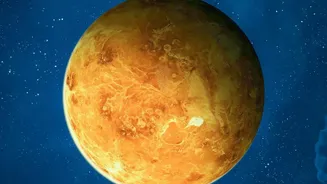
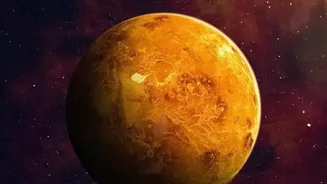
There are several reasons Venus shines so brightly. It’s our closest planetary neighbour, and its size is similar to Earth's, earning it the nickname 'Earth's twin'. More importantly, it’s completely covered in thick, highly reflective clouds that bounce about 77% of sunlight back into space, making it appear far more brilliant than any actual star. At this elongation, it will shine at a magnitude of -4.4, making it the brightest object in the night sky after the Moon. Despite its beautiful appearance, Venus is an incredibly harsh world, with surface temperatures hot enough to melt lead and an atmosphere of carbon dioxide and sulfuric acid clouds.
How to See Venus on August 15
The good news is that you don't need any special equipment to see Venus; its brilliance makes it easily visible to the naked eye. The best time to look is shortly after sunset. Find a spot with a clear, unobstructed view of the western horizon. As the colours of twilight begin to fade, you will see Venus emerge as a piercingly bright, steady point of light. Unlike stars, which tend to twinkle, Venus’s light is usually a constant, creamy-white glow. The planet will be relatively low in the sky, so a viewing spot without tall trees or buildings in the way is crucial. On the evening of August 15, the crescent Moon will also be nearby, making for an especially scenic pairing.
Enhancing Your View
While your eyes are enough, a simple pair of binoculars can enhance the experience. Through binoculars, you won’t see surface details due to Venus's thick clouds, but you will be able to appreciate its brightness and, most excitingly, see its phase. Just like our Moon, Venus goes through phases. Around its greatest elongation on August 15, Venus will appear roughly half-illuminated, like a tiny first-quarter moon. A small telescope will make this phase even clearer. For the sharpest views, try to find a night with steady air, when stars are not twinkling excessively. Let your eyes adjust to the dark for about 20-30 minutes to get the best possible view of the night sky.