






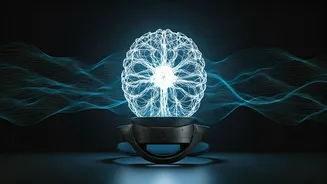


Decoding Thoughts into Text
Meta recently unveiled Brain2Qwerty v2, an advanced AI system that can translate brain activity into text. Unlike invasive methods that require surgically implanted electrodes, this technology works non-invasively. It uses a helmet-like device for magnetoencephalography
(MEG) to measure the faint magnetic fields produced by brain activity. An AI model then decodes these signals in real-time to reconstruct the sentences a person intends to type. The primary goal is to develop a safe and effective communication tool for individuals who have lost the ability to speak or move due to conditions like brain injuries, ALS, or locked-in syndrome. By making the underlying code for both v1 and v2 available, Meta hopes to accelerate neuroscience research and the development of new diagnostic and treatment tools.
A Major Leap in Accuracy
The most striking thing about Brain2Qwerty v2 is its dramatic improvement over previous versions and competing non-invasive methods. The new system achieves an average word accuracy of 61%, with the best-performing participant reaching an impressive 78%. To put that in perspective, Meta notes that prior non-invasive techniques hovered around just 8% word accuracy. This jump moves the technology from a theoretical curiosity toward a potentially viable assistive tool. In the most successful tests, more than half of the sentences decoded from brain activity had one word error or less. While still not perfect for everyday conversation, it represents a significant narrowing of the gap that once existed between non-invasive systems and their surgical counterparts.
The Secret Sauce: More and Better Data
The headline of the story isn't just the accuracy, but how it was achieved. The key difference between v1 and v2 was data. To train the new model, researchers recorded nine volunteers for about 10 hours each while they actively typed sentences. This generated a dataset of approximately 22,000 sentences correlated with MEG brain scans—about ten times more data per person than the first version. Researchers found that the model's accuracy improved in a predictable, log-linear fashion with the amount of data it was fed. This scaling relationship is the core takeaway: it suggests that the path to even higher accuracy isn't necessarily a radical new algorithm, but simply collecting more high-quality training data. The gap with surgical implants, Meta suggests, could be significantly bridged through data scaling alone.
How the AI Pipeline Works
Brain2Qwerty v2 uses a sophisticated, multi-stage AI pipeline. First, a deep learning model analyzes the raw MEG signals to decode them into characters. Unlike older systems that relied on hand-crafted methods to spot neural events, this model learns directly from the brain data. From there, another AI system helps organize the characters into words. Finally, a large language model (LLM), similar to the technology behind chatbots, takes over. This LLM uses its understanding of language and context to turn the jumble of decoded characters and words into coherent, grammatically correct sentences, correcting errors along the way. This is the first time an LLM has been successfully used to structure noisy brain activity into intelligible sentences, creating a new blueprint for future brain-computer interface (BCI) research.
The Road Ahead: Hurdles and Hopes
Despite the breakthrough, Brain2Qwerty is still a research project, not a consumer product. A major practical hurdle is the hardware itself. Current MEG scanners are massive, expensive machines, making them impractical for use outside of a lab. While there are promising advancements in developing smaller, more manageable sensors, the technology is not yet ready for clinical or home use. Furthermore, while the accuracy is much improved, a 61% average rate is still challenging for fluid conversation. However, the open-sourcing of the code and data is expected to spur wider academic and commercial research. By proving that performance scales with data, Meta has illuminated a clear, if challenging, path forward for non-invasive BCIs, offering real hope for a future where technology can restore a voice to those who have lost it.