




The Classic Story of the Moon's Birth
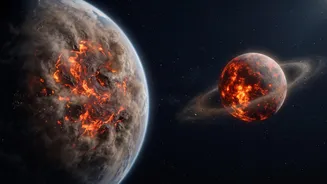
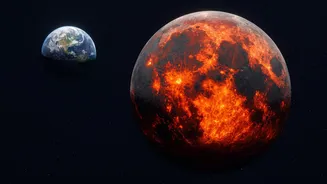
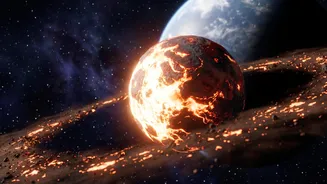
For much of modern science, the story of the Moon has been a dramatic, slow-burn epic. The leading theory, known as the 'giant-impact hypothesis', posits that about 4.5 billion years ago, a Mars-sized planet named Theia collided with a young, molten Earth.
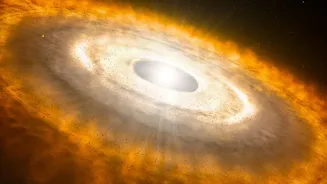
The cataclysmic impact would have blasted a massive cloud of rock and debris into space. Over hundreds, or even thousands, of years, gravity would have slowly pulled this orbiting debris ring together, eventually forming the Moon we see today. This theory elegantly explained many of the Moon's mysteries, including its smaller iron core and why lunar rocks brought back by Apollo astronauts showed a chemical composition so similar to Earth's mantle. For years, this was the accepted narrative: a violent collision followed by a long and gradual assembly.
A New, High-Speed Origin Story
Now, that long-held narrative is being questioned by a far quicker and more dramatic alternative. Using incredibly powerful supercomputers, scientists have created new, high-resolution simulations of the ancient impact. Researchers at institutions like NASA's Ames Research Center and Durham University have found that under certain conditions, the Moon might not have formed from a debris ring at all. Instead, the collision could have launched a huge, intact chunk of material directly into a stable orbit. This proto-Moon, a single massive body, could have been born in a matter of hours, not millennia. Some of the latest simulations, published in The Astrophysical Journal Letters, suggest a timeframe as short as five hours. This 'immediate-satellite' scenario doesn't just speed up the timeline; it fundamentally changes the mechanics of how the Moon came to be.
Why the New Theory Is a Game-Changer
The five-hour formation isn't just a faster version of the old story; it helps solve a major headache in planetary science. A long-standing problem with the classic giant-impact theory was the 'Theia problem'. If the Moon formed mostly from the debris of the impacting planet, Theia, it should have a very different chemical signature from Earth. Yet, analysis of Apollo moon rocks shows their isotopic makeup is remarkably similar to Earth's. The rapid-formation model provides a potential solution. In these high-speed, direct-launch scenarios, the simulations show that the outer layers of the resulting Moon are made of material from Earth's mantle, not just the impactor. This could explain the compositional similarities that have puzzled scientists for decades, without needing to assume that Earth and Theia were coincidentally identical to begin with.
From Simulation to Solid Proof
It’s crucial to remember the second part of the headline: 'Not Yet Proven'. While these high-resolution simulations are compelling, they are still computer models. As lead researcher Jacob Kegerreis and others point out, this opens a new range of possibilities but doesn't close the case. The simulations show what is physically possible, not necessarily what actually happened. The outcome of the impact appears to depend heavily on factors like the temperature and material strength of the proto-Earth and Theia at the time of collision. The real proof will lie, as it did for the first theory, in rocks. Future lunar missions, like NASA's Artemis program, plan to collect new samples from different regions of the Moon, including its far side. Analyzing these new samples for clues about their origin and composition will be the key to testing whether our Moon had a long, drawn-out birth or was created in the blink of a cosmic eye.