





First, What Is a Blazar?
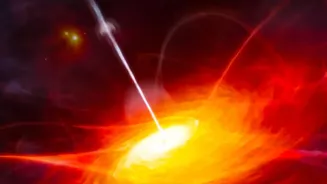
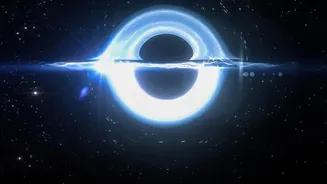
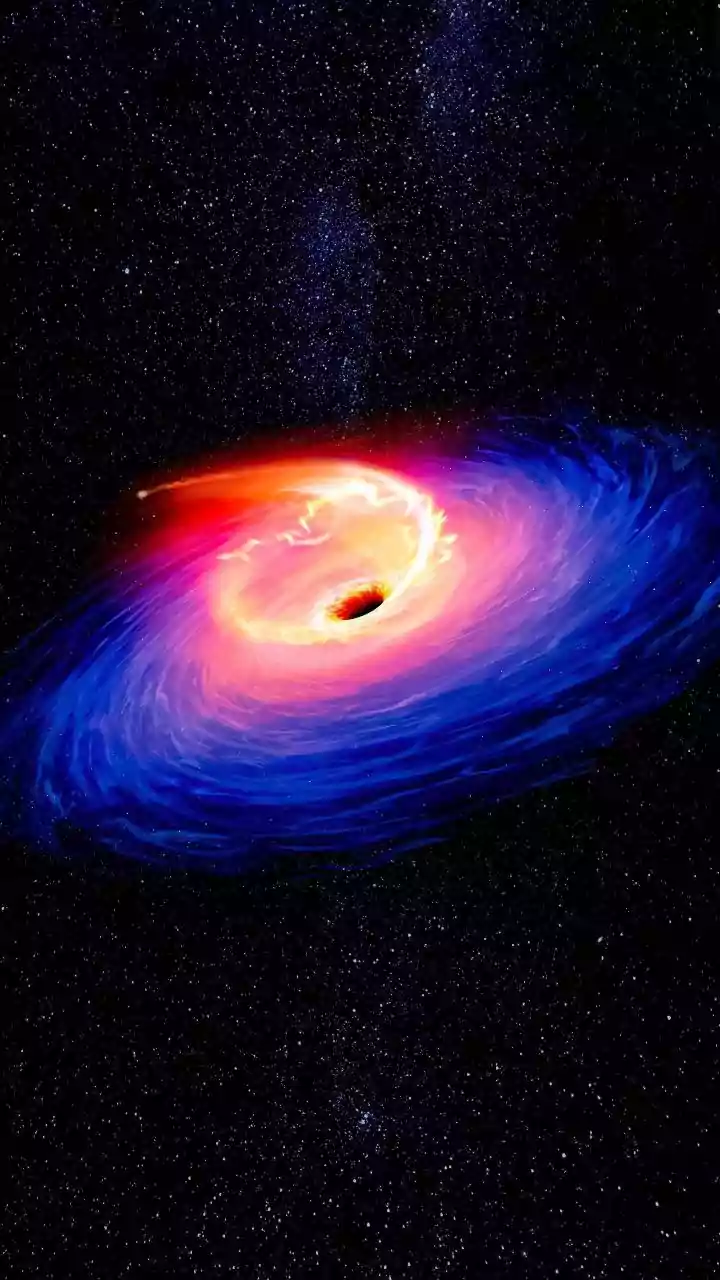
To understand the recent news, we first need to talk about blazars. Imagine a supermassive black hole at the center of a distant galaxy. As it pulls in surrounding gas and dust, not all of it falls in. Some of this material gets superheated and funnelled
into two powerful jets of plasma and radiation that blast out from the black hole's poles at nearly the speed of light. These jets can stretch for millions of light-years. A blazar is what we call one of these systems when one of its jets happens to be pointed almost directly at Earth. Because we're looking straight down the barrel, it appears incredibly bright and energetic to us.
So, What Is a 'Microblazar'?
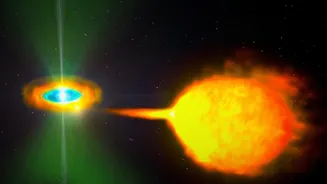
A microblazar is essentially a miniature version of a blazar. The key difference is the size of the black hole. Instead of a supermassive black hole millions or billions of times the mass of our Sun, a microblazar is powered by a much smaller, stellar-mass black hole, perhaps only ten times the Sun's mass. These smaller black holes are part of a binary system, meaning they are locked in orbit with a companion star. The black hole pulls material from its companion star, creating an accretion disk and launching jets, just like its supermassive cousins. When one of those jets is aimed our way, we call it a microblazar.
The Recent Discovery Explained
Astronomers recently confirmed the first-ever microblazar within our own Milky Way galaxy, a system named IRAS 18293−0941. This object, which had been theorised to exist for decades, was finally identified about 12,000 light-years from Earth. It consists of a black hole about ten times the mass of the Sun, orbiting a massive star and siphoning material from it. Using a combination of radio telescopes, scientists confirmed that one of its jets, travelling at around 75% the speed of light, is pointed almost directly at us. This was a landmark discovery that had been hiding in plain sight, obscured by a thick veil of interstellar dust.
Why Earth Is Perfectly Safe
The phrase 'a jet of plasma is being blasted at Earth' naturally causes concern, but the danger is non-existent. The primary reason is immense distance. At 12,000 light-years away, IRAS 18293-0941 is simply too far for its jet to have any effect on us. For context, one light-year is about 9.5 trillion kilometres. The energy from the jet dissipates over this vast cosmic expanse, arriving as faint radio signals that are harmless. While the jet is powerful, accelerating particles to incredible energies, it poses no realistic hazard to Earth by any current scientific measure. Any hypothetical danger would only exist if such an object were dramatically closer, which this one is not.
A Cosmic Laboratory, Not a Weapon
Instead of a threat, astronomers see this discovery as a tremendous opportunity. Finding a microblazar in our own galaxy gives us a 'nearby' laboratory to study phenomena that were previously only observable in extremely distant galaxies. Full-sized blazars are too far away for us to see the details of how their jets form and interact with their surroundings. IRAS 18293-0941 allows for a much closer look. It helps scientists understand how black holes accelerate particles to such high energies—in this case, energies 100 times greater than what our most powerful particle accelerator, the Large Hadron Collider, can achieve. It's a chance to test theories about extreme physics on a more manageable cosmic scale.