





Celestial Misfits: What Are Brown Dwarfs?
Imagine an object that starts life like a star but never quite makes it. That's a brown dwarf. First discovered in the 1990s, these objects form from the collapse of large gas clouds, just like stars do. However, they don't accumulate enough mass to kickstart
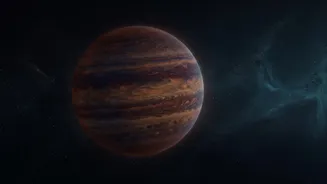
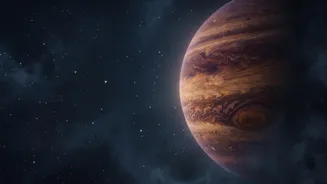
the nuclear fusion of hydrogen in their cores, the process that makes stars like our Sun shine brightly. Often called 'failed stars', they are more massive than planets, weighing between 13 and 80 times the mass of Jupiter, but they lack the engine of a true star. Instead, they are born hot and simply cool down over billions of years, glowing dimly in infrared light. Because they don't orbit a bright host star, they drift alone in the darkness, making them fascinating, isolated laboratories for studying planetary and stellar physics.
A New Cosmic Detective in the Sky
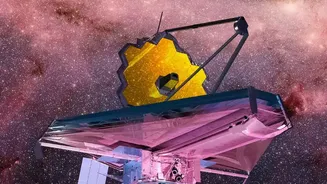
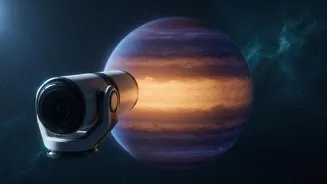
To study these dim and distant objects, astronomers need powerful tools. Enter NASA's SPHEREx (Spectro-Photometer for the History of the Universe, Epoch of Reionization, and Ices Explorer). Launched in March 2025, this space telescope is on a mission to map the entire sky in near-infrared light, which is invisible to the human eye but perfect for spotting the faint heat of brown dwarfs. While its primary goals include understanding the early universe and the origins of life-sustaining molecules, SPHEREx is proving to be an exceptional brown dwarf hunter. It does this using spectroscopy, which breaks down light into its component colors. By analyzing these 'light signatures', scientists can identify the chemical molecules present in a brown dwarf's atmosphere, such as water, methane, and carbon dioxide. SPHEREx is creating a map of the sky in 102 different colors, providing an unprecedented level of detail.
Uncovering Weather on Failed Stars
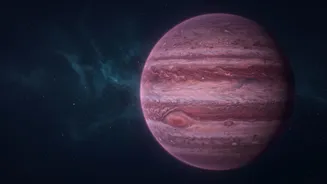
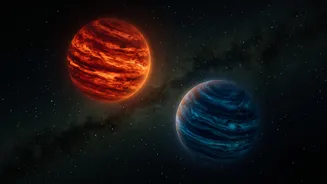
The latest findings from SPHEREx, based on observations of 37 nearby brown dwarfs, are revealing that these worlds are far from uniform. The study shows that the atmospheric patterns on brown dwarfs are distinct and appear to change as the objects get older and colder. As they cool, their exotic cloud layers can thin out, changing the chemical makeup of the atmosphere that the telescope can see. One of the key revelations is that no two brown dwarfs are exactly alike; even at the same temperature, their light spectra can look surprisingly different. This diversity challenges existing atmospheric models, which have struggled to accurately predict the transition from cloudy to clear atmospheres. These findings suggest complex, dynamic weather systems, turning astronomers into 'accidental meteorologists' as they map out these distant storms.
A Bridge to Understanding Giant Planets
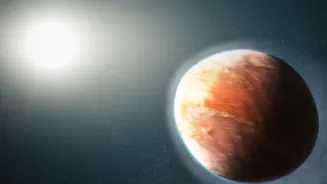
Why does the weather on a failed star millions of kilometers away matter? Because brown dwarfs are excellent stand-ins for giant gas planets, or 'super-Jupiters', found orbiting other stars. These massive exoplanets are often incredibly difficult to study directly because the blinding light from their parent star washes them out. Brown dwarfs, however, often drift through space alone, making their atmospheres much easier to observe in detail. Since they share similar temperatures, masses, and complex atmospheres with gas giants, studying a brown dwarf is like getting a clean look at a Jupiter-like world without the stellar glare. The rich chemical atmospheres SPHEREx is detecting on brown dwarfs, full of water, carbon monoxide, and methane, are not unlike what we see in the giant planets of our own solar system. This makes them a crucial bridge for understanding planet formation and atmospheric dynamics across the galaxy.