
A Celestial Collaboration
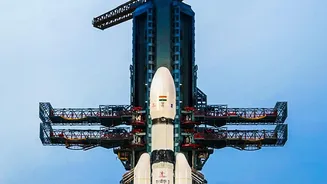
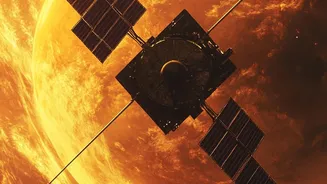
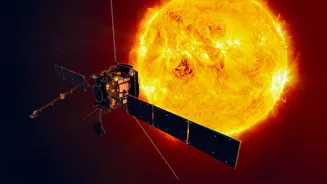
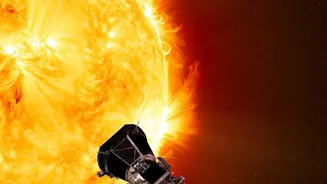
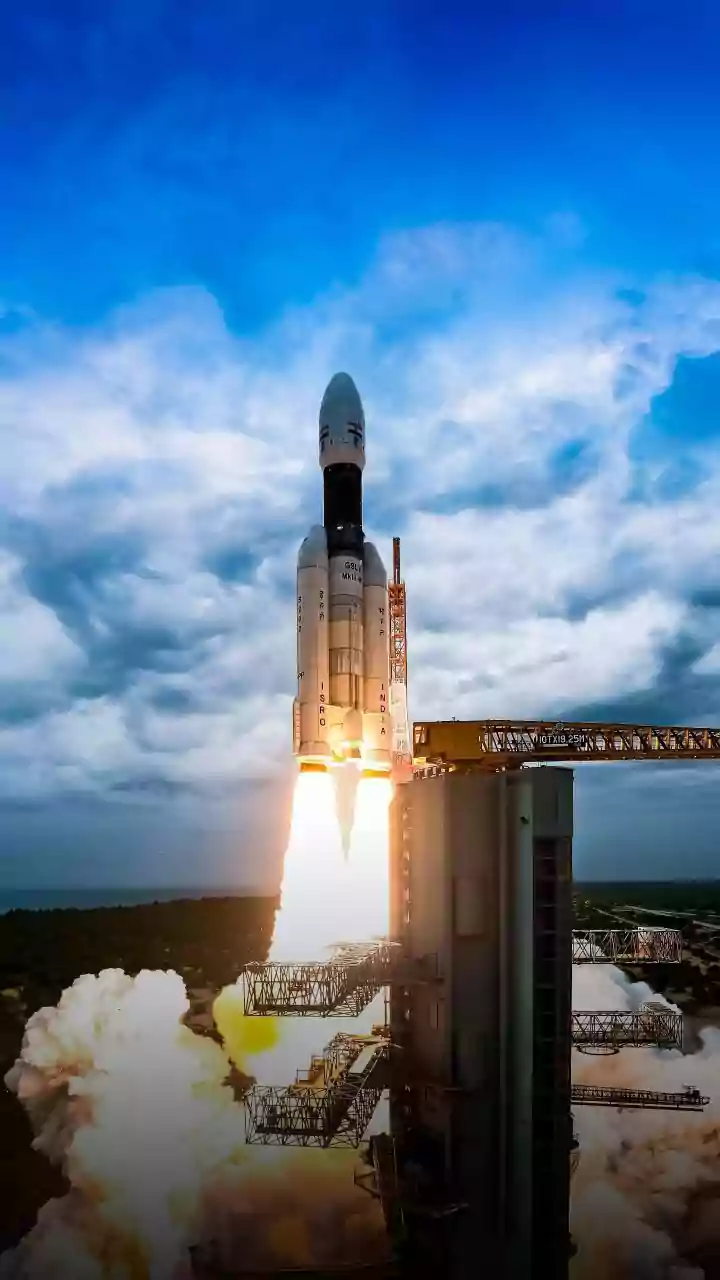
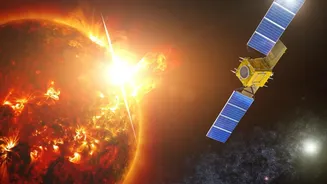
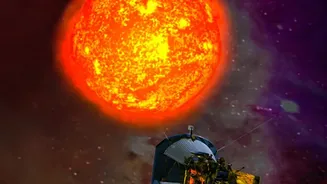
The groundbreaking research stems from a powerful partnership between the Indian Space Research Organisation (ISRO) and the European Space Agency (ESA). ISRO's Aditya-L1 is India's first dedicated mission to study the Sun, positioned 1.5 million kilometres
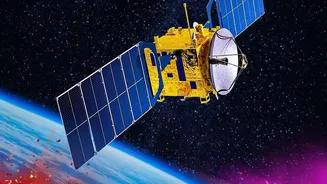
from Earth to get an uninterrupted view. Its key instrument in this study is the Visible Emission Line Coronagraph (VELC), which performs spectroscopy on the Sun's corona—its superheated outer atmosphere. This allows scientists to measure properties like gas temperature and density. Complementing Aditya-L1 is ESA's Proba-3, the world's first precision formation-flying mission. It consists of two satellites flying in a tight 150-metre formation to create a perfect artificial solar eclipse in space. This allows its ASPIICS coronagraph to capture incredibly sharp images of the faint corona very close to the Sun's disk, a region notoriously difficult to observe. By combining the spectroscopic data from VELC with the clear images from ASPIICS, scientists can get a more complete, cross-checked view of solar phenomena than ever before.
Decoding Solar Tempests
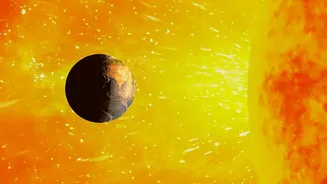
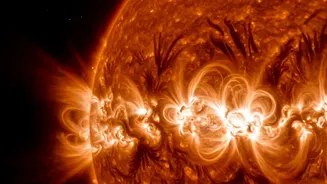
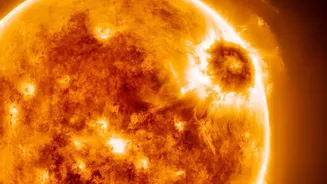
The focus of the joint study was Coronal Mass Ejections, or CMEs. These are among the most violent events in our solar system. A CME is a colossal eruption where the Sun expels billions of tonnes of magnetised plasma into space at speeds of hundreds of kilometres per second. While many CMEs miss our planet, those directed towards Earth can have serious consequences. When a CME collides with Earth's magnetic field, it can trigger geomagnetic storms. These storms are responsible for the beautiful auroras but can also disrupt our technologically dependent society. They pose a threat to astronauts in orbit, can damage critical satellites used for communication and navigation, and even cause surges in power grids on the ground. Understanding how CMEs form and accelerate is therefore crucial for improving 'space weather' forecasts and protecting our infrastructure.
The Breakthrough Observations
The India-Europe team analysed two CMEs that occurred in September 2025, which were simultaneously recorded by both Aditya-L1 and Proba-3. The findings, published in the journal 'Astronomy & Astrophysics', revealed distinct behaviours in the eruptions' earliest moments. The first CME, observed on September 14, was fast, travelling at about 645 km/s. In this event, thermal energy (heat) accounted for only about 1% of the eruption's total energy. The second CME, on September 16, was much slower, moving at around 145 km/s. Crucially, in this slower eruption, the thermal energy grew until it was comparable to the kinetic energy (energy of motion). Furthermore, the slower CME showed signs of stronger early expansion, as its density dropped more steeply with height. These details about how energy is distributed and how the structure evolves just moments after eruption were previously very difficult to measure.
A New Era for Space Weather Alerts
These findings are far more than just academic curiosities. They represent new observational constraints that can refine the physical models used to predict the behaviour of CMEs. By understanding the different ways eruptions can begin—some fast and kinetically driven, others expanding more slowly with a different energy profile—scientists can better forecast their potential impact. The ability of Aditya-L1's VELC to catch the CMEs at their earliest stage was key, providing data that was then complemented by the sharp imaging from Proba-3. This synergy demonstrates the immense scientific value of coordinated international observations. Having independent measurements of mass and energy from two different instruments that closely agreed has strengthened confidence in the results significantly. This improved understanding of the 'initial conditions' of a CME could one day lead to earlier and more accurate space weather alerts, giving operators more time to protect satellites and power grids from the fury of the Sun.