







For gold buyers, Dhanteras 2026 was a confusing time. After a blistering rally early in the year, prices saw a significant 'correction', creating a volatile and uncertain market just as festive buying began. What exactly is happening?
First, What Is a 'Price Correction'?
In financial markets,
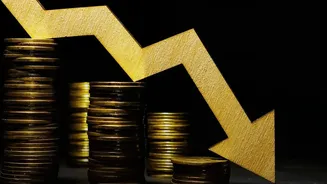
a 'correction' is a short-term price decline of at least 10%, but not more than 20%, from a recent peak. Think of it as the market taking a breather after a rapid run-up. This isn't a crash or a long-term bear market; it’s a temporary reversal that often happens when an asset's price has risen too quickly and speculative interest fades. Domestic gold prices experienced exactly this, falling more than 20% from their January 2026 peak of nearly ₹1,80,000 per 10 grams to around the ₹1,42,000 mark ahead of the festival.
The Global Tug-of-War on Prices
Gold's price in India is a function of two main things: the international price (denominated in US dollars) and the USD/INR exchange rate. Several global factors have been pulling the international price down. Chief among them are changing expectations around US monetary policy. When US interest rates rise or are expected to rise, holding a non-yielding asset like gold becomes less attractive, and money flows towards the dollar. A stronger dollar and higher US Treasury yields increase the opportunity cost of holding gold, putting downward pressure on its price.
Domestic Demand Meets High Prices
While global factors pressured prices, the Indian domestic market had its own dynamics. Festive buying for Dhanteras and the upcoming wedding season provided a strong backdrop for demand. However, the high price levels, even after the correction, have weighed on purchasing power. Reports indicate a significant divergence: consumers are spending more money but buying less gold in terms of volume. For instance, while jewellery demand rose sequentially in the third quarter of 2026, it remained about 20% lower than the same period last year. This shows that while the cultural drive to buy remains, affordability has become a major constraint.
Why the Market Feels So Volatile
Volatility refers to how much prices are swinging up and down. The current market is volatile because the forces influencing gold are pulling in opposite directions. On one hand, factors like higher interest rate expectations and a strong US dollar are pushing prices down. On the other, persistent geopolitical uncertainty, continued buying by central banks worldwide, and strong festive demand in India are providing support and pushing prices up. This conflict creates sharp, unpredictable movements. For example, in the two days leading up to Dhanteras, prices surged 4.56% on the back of US midterm election results, which weakened the dollar. This kind of rapid swing is the hallmark of a volatile market.
What This Means for Gold Buyers
For those who bought on Dhanteras, the price was still roughly 7–8% higher than on Dhanteras 2025, despite the major correction from the January 2026 peak. This highlights gold's long term performance as an asset, with one analysis showing an annualized return of over $16%$ in the last decade. The recent dip was seen by many long term investors as a buying opportunity. However, the volatility means that trying to 'time the market' for the absolute lowest price is extremely difficult. Analysts suggest that a staggered approach to buying, such as through systematic investment plans (SIPs) in digital gold or ETFs, can be a more prudent strategy in such a market. This averages out the purchase price over time, reducing the risk of buying everything at a temporary peak.