




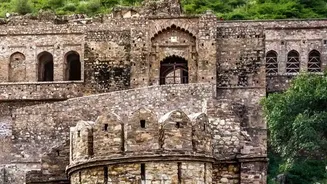
1. Mehrangarh Fort, Jodhpur
Rising 400 feet above Jodhpur, Mehrangarh Fort appears to emerge directly from the rocky hill it stands upon. Founded in 1459 by Rao Jodha, its imposing walls, which are up to 36 metres high, protect a complex of ornate palaces with intricate carvings
and expansive courtyards. The fort's museum offers a stunning glimpse into the Rathore clan's history, showcasing everything from royal palanquins to an armoury of historical weapons. Rudyard Kipling famously described it as a palace built by Titans, and standing on its ramparts, overlooking the blue city below, it’s easy to see why.
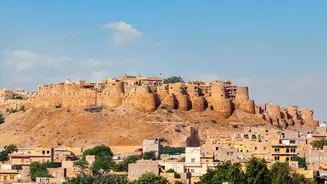
2. Jaisalmer Fort, Jaisalmer
Unlike most forts, which are preserved as monuments, Jaisalmer Fort is a living, breathing entity. Known as Sonar Quila or the Golden Fort, its yellow sandstone walls blend seamlessly with the Thar desert. Built in 1156, it is one of the few “living forts” in the world, with roughly a quarter of the old city's population still residing within its ancient walls. Wandering through its narrow, winding lanes feels like stepping back in time, with homes, shops, temples, and even hotels operating inside the fortifications. This unique blend of past and present makes it an unforgettable experience.
3. Chittorgarh Fort, Rajasthan
Chittorgarh is not just a fort; it is a symbol of Rajput pride, sacrifice, and resistance. As the largest fort in India, this UNESCO World Heritage Site sprawls across 700 acres on a high hill. Its history is marked by tales of epic heroism and tragedy, most notably the practice of Jauhar, where women of the court chose mass self-immolation to avoid capture by invading armies. The fort complex includes palaces, temples, and two famous commemorative towers—the Vijay Stambha (Tower of Victory) and the Kirti Stambha (Tower of Fame). To walk through Chittorgarh is to walk through the pages of a stirring, if heartbreaking, historical epic.
4. Amer Fort, Jaipur
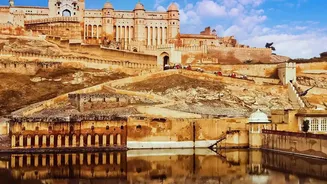
A stunning blend of Rajput and Mughal architectural styles, Amer Fort is a masterpiece of design. Situated on a forested hill overlooking Maota Lake, the 16th-century fort is built from red sandstone and marble. Its most famous attraction is the Sheesh Mahal, or Palace of Mirrors. The walls and ceilings of this hall are inlaid with thousands of tiny mirrors. Legend has it that it was designed so the queen could watch the stars even indoors, as a single candle flame is enough to illuminate the entire room in a cascade of shimmering light.
5. Golconda Fort, Hyderabad
Golconda Fort is a testament to brilliant engineering and acoustics. Originally a mud fort, it was expanded by the Qutb Shahi dynasty into a formidable granite fortress renowned for its diamond trade. Its most celebrated feature is its acoustic system: a handclap at the main gate can be heard clearly at the Bala Hisar pavilion, the highest point almost a kilometre away. This ingenious system served as an early warning mechanism, allowing guards to signal danger instantly across the vast complex. It’s a marvel of applied science in architecture.
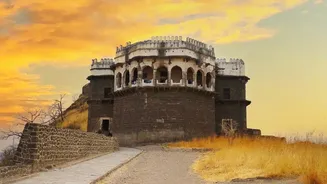
6. Daulatabad Fort, Maharashtra
Originally named Devagiri, Daulatabad Fort is the definition of a formidable stronghold. Built on a 200-meter-high conical hill, its defenses were designed to be virtually impenetrable. The fort is known for its series of clever military obstacles, including a steep, smooth rock face, multiple gates with sharp turns to break an army's charge, and a pitch-black, labyrinthine tunnel known as the Andheri, designed to confuse and trap invaders. Though it was captured through strategy and betrayal, it was rarely taken by direct assault, making it a masterpiece of medieval military architecture.
7. Gwalior Fort, Madhya Pradesh
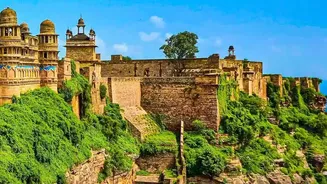
Dubbed “the pearl amongst the fortresses of Hind” by the Mughal emperor Babur, Gwalior Fort has a history stretching back to at least the 6th century. This sprawling hilltop fort has been ruled by numerous dynasties, each leaving its mark on the architecture. Inside its walls are several palaces, ancient temples, and water reservoirs. One of its most significant historical markers is a temple that contains one of the world's oldest depictions of the number 'zero' in a stone carving. Its sheer scale, diverse architecture, and long history make it one of India's most impressive citadels.