




The Cosmic Graveyard
Imagine a star like our Sun reaching the end of its life. After swelling into a red giant, it sheds its outer layers, leaving behind a scorching, ultra-dense core about the size of Earth. This is a white dwarf. These objects are incredibly dense, packing
the mass of a sun into a planetary-sized ball. For a long time, astronomers believed their colour was a straightforward indicator of temperature: the hottest ones glowed blue-white, and they cooled over billions of years into dimmer, redder objects. This seemed to be a predictable final chapter for about 97% of the stars in our galaxy, including our own Sun someday.
A Rainbow of Remnants
A recent study from astronomers at the University of Warwick has completely repainted this picture. By analysing the light spectra from these stellar remnants and running it through models of human vision, they calculated what these stars would actually look like up close. Instead of a simple palette, they discovered a dazzling array of possibilities, including pink, purple, yellow, and cyan. The findings, published in the journal RAS Techniques and Instruments, suggest that while most white dwarfs in a local sample are indeed white, about one in thirty could have an unusual hue. This isn't just a visual quirk; it points to complex physics happening in their atmospheres.
The Science of a Green Star
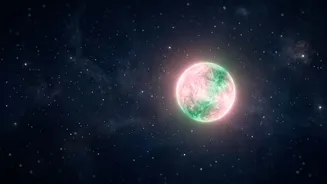
The most startling discovery was of white dwarfs that would appear green, a colour long thought impossible for stars. Stars typically emit a broad spectrum of light, and even those that peak in the green part of the spectrum also emit so much red and blue light that they just look white to our eyes. The researchers identified one star, WD J1330+6435, as the first-known genuinely green star. The secret is its unique and extremely dense atmosphere, which is polluted with rocky material from a former planetary system it 'ate'. Elements like sodium and calcium in this dense environment absorb huge chunks of the orange and violet parts of the light spectrum, leaving behind a ghostly green glow.
Pinks, Purples, and the Reddest Star
The cosmic colour palette doesn't end with green. The analysis found that different chemical compositions lead to different colours. White dwarfs with atmospheres rich in carbon, dredged up from their core through convection, tend to absorb light in a way that makes them appear pink or purple. One such star, WD J1011+2845, is so effective at this that it produces a deep salmon-pink glow, potentially making it the reddest star ever recorded. In other cases, white dwarfs polluted by asteroid debris take on a yellowish hue, while those with specific hydrogen-helium atmospheres can appear cyan.
Rewriting the Stellar Playbook
This discovery does more than just add new colours to the astronomical rainbow. It transforms white dwarfs into powerful diagnostic tools. By analysing the 'pollution' in their atmospheres, scientists can effectively perform an autopsy on destroyed planetary systems, measuring the chemical makeup of the asteroids and planets that once orbited the star. This provides invaluable clues about how planetary systems form and evolve. The fact that a star's final appearance can be so dramatically altered by its chemical environment, rather than just its temperature, opens up new avenues for understanding the physics of matter under extreme pressure and density.