


A New Look at a Cosmic Lion
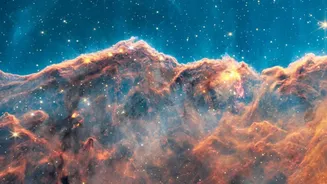
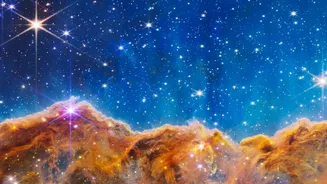
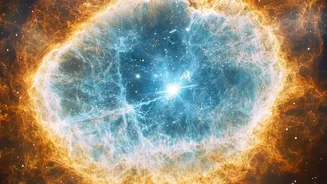
The latest subject of the James Webb Space Telescope's powerful gaze is NGC 2392, a celestial object located roughly 6,500 light-years away in the constellation Gemini. Nicknamed the Lion Nebula for its resemblance to a lion's mane, this object has been
observed before by telescopes like Hubble. However, Webb's advanced infrared instruments, NIRCam and MIRI, provide a much clearer and more detailed view. While previous images in visible light showed its general shape, Webb's infrared vision pierces through the obscuring dust, highlighting features like compact clumps of surviving dust and a shimmering haze of ionised gas. This new portrait reveals the complex, cavernous bubbles and delicate, filament-like structures of the nebula with unparalleled clarity.
The Beautiful End of a Star's Life
Despite its name, a planetary nebula has nothing to do with planets. The term is a historical holdover from when these round objects resembled planets through early telescopes. Instead, a planetary nebula represents the final, glorious chapter in the life of a star similar in mass to our own Sun. When such a star exhausts the hydrogen fuel in its core, it becomes unstable, swells dramatically, and begins to shed its outer layers into space. These expelled shells of gas and dust are then illuminated by the intensely hot stellar core left behind, creating the glowing, intricate structures we observe. NGC 2392 is a perfect example of this process, a snapshot of stellar death that has been unfolding for thousands of years.
At the Centre: A Hot White Dwarf
At the heart of NGC 2392, appearing like the 'nose' of the lion, is the remnant of the star that created this spectacle: a hot, dense white dwarf. This is the collapsed core of the original star. Though small, it is incredibly energetic. With a surface temperature estimated to be around 40,000 to 50,000 Kelvin, its fierce ultraviolet radiation energises the surrounding gas, causing it to glow. At the same time, a powerful stellar wind, moving at immense speeds, slams into the slower-moving material that was ejected earlier, carving out the nebula's complex double-shell structure. The new Webb image allows scientists to study this interaction between the star's radiation and the surrounding material in greater detail than ever before.
Why Webb's Infrared View Is Crucial
Observing in infrared light is key to understanding objects like NGC 2392. Infrared radiation can penetrate the clouds of cosmic dust that would normally obscure our view in visible light. This allows Webb to see the finer details of the nebula's structure, including dense clumps of dust that have survived the onslaught of the central star's radiation. These clumps, in turn, protect the material lying behind them, creating the long, comet-like tails that form the lion's 'mane'. By analysing the different infrared wavelengths, astronomers can map the temperature, composition, and density of the gas and dust. This helps them build a more complete model of how planetary nebulae form and evolve, a process responsible for creating much of the observable dust in the universe.
A Glimpse into Our Sun's Distant Future
Studying NGC 2392 isn't just an academic exercise in observing distant objects; it's also a preview of our own solar system's fate. In about five billion years, our Sun will run out of its core fuel and go through a similar process. It will expand into a red giant, shedding its outer layers to form its own planetary nebula, while its core collapses into a white dwarf. By observing nebulae like NGC 2392 at different stages, astronomers can piece together the timeline of stellar evolution for the most common type of stars in the universe. Each new observation from Webb provides another crucial piece of the puzzle, freezing a moment in time of a process that will eventually disperse over about 10,000 years — a mere blink of an eye in cosmic terms.