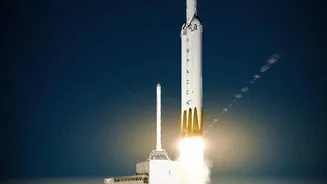









A Landmark Flight Achieved
SpaceX's latest test flight, designated Flight 14, has marked the program's most significant achievement to date: reaching Earth's orbit. The colossal rocket lifted off from Starbase, Texas, and although one of its upper-stage engines shut down prematurely,
the vehicle compensated and successfully pushed into orbit. It soared to an altitude of about 275 kilometres, a key objective for the mission. After a flight that lasted roughly three hours, the spacecraft performed a deorbit burn, plunged through the atmosphere, and executed a splashdown in the Pacific Ocean. While the mission was cut short from its original 10-hour plan, achieving a stable orbit and a controlled reentry represents a massive validation of the world's largest and most powerful rocket system. The Super Heavy booster also completed its mission, splashing down in the Gulf of Mexico as planned.
More Than Just Another Test
This flight was far from a routine launch; it was the first time Starship was used for an operational mission, deploying 26 of SpaceX's next-generation Starlink satellites into the constellation. This demonstrates a crucial capability for the company's business model, as Starship is designed to deliver significantly more payload to orbit than its workhorse Falcon 9 rocket, thereby reducing launch costs. The success of Flight 14 is built on an iterative design philosophy, where previous test flights—many of which ended in spectacular explosions—provided invaluable data. Surviving the intense heat of atmospheric reentry and achieving a targeted splashdown shows that the vehicle's heat shield and control systems are maturing, moving the program from a purely developmental phase toward becoming a working vehicle.
NASA's Moon Mission on the Line
Officials at NASA were watching this flight with immense interest, as their plans to return American astronauts to the Moon are directly tied to Starship's success. NASA selected Starship to serve as the Human Landing System (HLS) for its Artemis program, which will ferry astronauts from lunar orbit down to the surface. Without a proven, reliable Starship, the timeline for the Artemis III and IV missions, which aim for a lunar landing in the late 2020s, would be in serious jeopardy. This successful orbital flight is a critical proof point that gives NASA confidence that SpaceX can deliver on its ambitious contract. While this was an uncrewed flight, every milestone achieved brings the crewed lunar lander variant one step closer to reality.
The Path to Reusability
At the core of the Starship program is the goal of full and rapid reusability, a concept that promises to revolutionize access to space. Unlike traditional rockets that are discarded after one use, both the Super Heavy booster and the Starship upper stage are designed to be recovered, refurbished, and flown again. This flight's controlled return is a fundamental step in proving that the vehicle can withstand the journey to space and back. Future milestones will include demonstrating in-space propellant transfer, where one Starship refuels another in orbit—a necessary step for long-duration missions to the Moon and Mars. The ultimate goal is to catch the returning booster and spacecraft with giant mechanical arms on the launch tower, enabling a rapid turnaround for the next launch.