





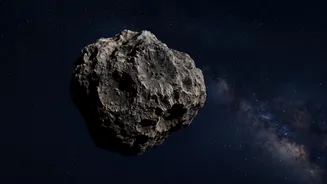
The Problem with Perfect Spheres
For years, planning for planetary defense involved a convenient simplification. To make the incredibly complex calculations manageable, computer models treated asteroids as simple, uniform spheres. This made the math easier, but it ignored a fundamental
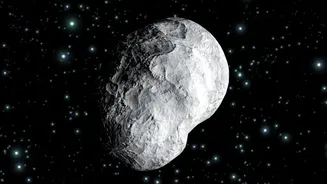
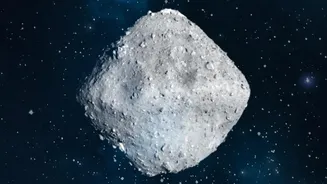
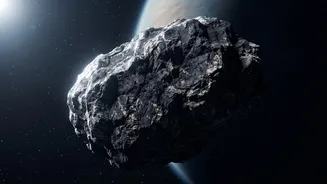
truth: real asteroids are lumpy, irregular, and unpredictable. They are often 'rubble piles' of loosely consolidated material or solid bodies with bizarre, uneven shapes, like potatoes or peanuts. As physicist Nathan Moore of Sandia National Laboratories puts it, 'spherical asteroids don't exist'. This discrepancy between the models and reality has been a nagging uncertainty for scientists. Missions like NASA’s DART, which successfully impacted the asteroid moonlet Dimorphos in 2022, provided a wealth of real-world data, confirming that shape and composition dramatically affect the outcome of an impact. The DART impact didn't just change the asteroid's orbit; it completely reshaped it.
A Breakthrough in Speed and Realism
The new study, led by Moore and his team at Sandia, overcomes this old limitation by combining two things that were previously incompatible: realistic asteroid shapes and high-fidelity physics calculations. Before, researchers had to choose one or the other. Modeling a lumpy shape meant simplifying the physics, while detailed physics required a simple sphere. The team developed a new algorithm that is over 1,600 times faster, making it possible to run highly detailed simulations on complex shapes without needing an impossible amount of computing power. 'With the old models, computers just couldn't handle it,' Moore said. This breakthrough allows scientists to upload high-resolution 3D models of actual asteroids—like Bennu, Itokawa, and Golevka, which are known to be highly irregular—and simulate what happens when they are hit.
Why Aiming at a Lumpy Rock Is Tricky
The new simulations reveal just how much an asteroid’s shape matters. The study focused on a 'stand-off' nuclear detonation, where the device explodes near the asteroid, bathing one side in X-rays. This vaporizes surface material, creating a powerful push, like a rocket engine. The researchers found that for the same asteroid, hitting it from different angles could produce wildly different results. For one simulated asteroid, the deflection velocity—the change in its speed—was nearly five times greater when targeting one side compared to another. Another simulation showed the resulting spin, or rotational speed, could vary by a factor of 17. 'We expected aim to matter,' Moore noted, 'What surprised us was how much.' Hitting a protruding feature might create a powerful, focused push, while hitting a concave area could diffuse the energy. An off-center hit can also send the rock tumbling, making its future path even harder to predict.
A New Toolkit for Planetary Defense
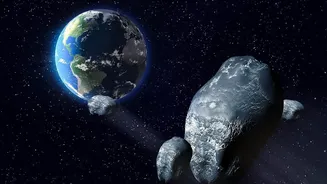
This research provides a crucial new tool for planetary defense strategists. While a kinetic impactor like DART is the preferred method for deflecting a threat with ample warning time, a nuclear option is considered a last resort for late-time interceptions of large objects. Being able to accurately model the outcome is critical. These faster, more realistic simulations allow mission planners to run numerous scenarios to find the optimal place to target a threatening asteroid to achieve the desired nudge without accidentally shattering it into a deadly cloud of debris. The model can generate heat maps showing which parts of the surface vaporize and calculate the resulting push and rotation. While there are still limitations—the model does not yet predict the breakup of the entire asteroid body—it represents a significant leap forward. Following the DART mission, the European Space Agency's Hera mission is currently on its way to the Didymos system to conduct a detailed post-impact survey, which will provide even more data to refine these models.