



What Is a 'Planetary Fingerprint'?
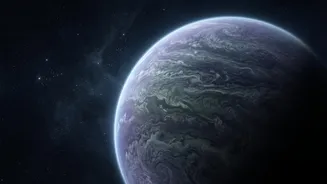
Think of a planetary fingerprint as a unique chemical signature that tells a story about a planet’s past and present. This signature is embedded in a planet’s atmosphere and can include clues about its formation, its geology, and most tantalizingly, whether
it harbors life. Scientists look for specific gases and elements that, when found together, create a profile of the world. For instance, the combination of lots of oxygen with a bit of methane is considered a strong potential biosignature here on Earth, as life constantly produces both. The goal for astronomers is to detect these atmospheric chemicals on distant exoplanets and interpret what they mean. Much like a detective dusting for fingerprints at a crime scene, scientists are looking for a pattern that can only be explained by specific processes, whether geological or biological.
The Role of Solar Chemistry
This is where a star's light comes into play. Solar chemistry, or photochemistry, refers to chemical reactions driven by the energy from light. On any planet with an atmosphere, the light from its parent star is constantly bombarding gas molecules. This energy can break molecules apart, cause them to recombine in new ways, or excite them into reactive states. This process is fundamental to life on Earth—photosynthesis is a prime example of photochemistry. But it can also happen without life. Researchers are now realizing that these very photochemical reactions can either create misleading signals or, more excitingly, preserve genuine clues. A star’s intense radiation can create unique chemical byproducts in an atmosphere, effectively stamping it with a lasting record of the conditions there. This process could help lock in evidence of a planet’s history for billions of years.
What the New Research Suggests
Recent studies are revealing just how powerful solar chemistry can be in this context. In one area of research, scientists are exploring how the interaction between a star and its planets can alter the star itself. Some studies suggest that sun-like stars that have consumed planets show different chemical compositions, such as lower levels of lithium. This implies that the 'fingerprint' of a planet can be left on its star. On exoplanets, photochemistry plays a crucial role in creating or destroying potential biosignatures. For example, ultraviolet radiation from a star can break down water molecules into hydrogen and oxygen. On a lifeless planet, this could create an oxygen-rich atmosphere that falsely suggests the presence of photosynthesis—a 'false positive'. The new understanding is that by modeling the specific type of star and the intensity of its light, scientists can better predict what chemical signatures are natural products of photochemistry versus those that might point to something more.
How This Helps the Search for Life
This research is a game-changer for astrobiologists. For decades, the search for extraterrestrial life has focused on finding 'Earth-like' planets with biosignatures like oxygen. However, we now know that planetary processes can create oxygen without life. The new focus is on context. By understanding the photochemical 'rules' of a specific star system, scientists can more effectively distinguish between a dead planet with a tricky atmosphere and one that might genuinely harbor a biosphere. For example, telescopes like the James Webb Space Telescope (JWST) can analyze the light passing through an exoplanet's atmosphere to detect its chemical makeup. Armed with better models of solar chemistry, astronomers can interpret that data with far more confidence. It helps them decide which chemical imbalances are truly strange and which are just the expected result of a star blasting its planet with radiation.
What It Means in Practice
In practice, this means the hunt for alien life is becoming smarter and more nuanced. Instead of just looking for a single chemical like oxygen, scientists will look for atmospheric cocktails that defy easy photochemical explanation. It also widens the net. A planet that might have been dismissed for having a seemingly 'non-biological' atmosphere might be reconsidered once solar chemistry is factored in. Future observations will be planned around this principle. Scientists will not only point telescopes at a planet but also study its star in minute detail. The star's age, temperature, and radiation output all become critical pieces of the puzzle. This allows researchers to build a more complete picture of the planetary environment and assess whether it could realistically support life, or if its atmosphere is simply a beautiful but lifeless chemical light show.