





A Landmark Solar Partnership
Scientists from the Indian Institute of Astrophysics (IIA) in Bengaluru, alongside international collaborators, have achieved a significant milestone in our quest to understand the Sun. For the first time, they have combined observations from two of the world's
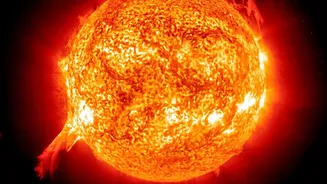
most advanced solar missions—India’s Aditya-L1 and Europe’s Proba-3—to decode the behaviour of Coronal Mass Ejections (CMEs) near their birthplace. These massive eruptions of plasma and magnetic fields from the Sun can have significant impacts on Earth, affecting satellites, communication networks, and power grids. The new study, published in the prestigious journal 'Astronomy & Astrophysics', provides a more complete picture of these phenomena than ever before.
India’s Unblinking Eye on the Sun
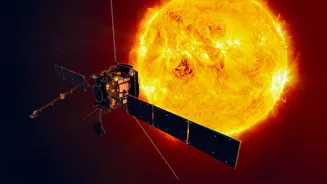
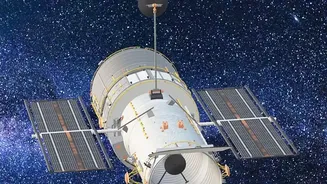
At the heart of this achievement is Aditya-L1, India's first dedicated solar observatory. Launched by ISRO in September 2023, the spacecraft is strategically positioned at the Sun-Earth Lagrange point 1 (L1), about 1.5 million kilometres from Earth. This unique vantage point allows for a continuous, uninterrupted view of the Sun. The mission's key instrument for this study is the Visible Emission Line Coronagraph (VELC). Developed by the IIA, the VELC is designed to study the solar corona by taking spectroscopic observations, essentially breaking down the light from the corona to analyse its properties like temperature, velocity, and density.
Europe’s Artificial Eclipse in Space
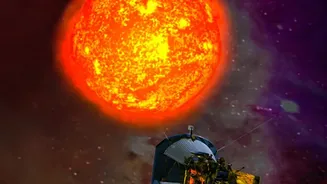
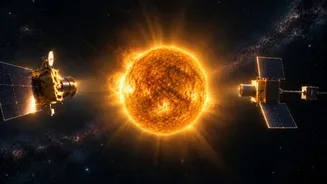
The other half of this dynamic duo is ESA’s Proba-3, a mission that is itself a marvel of engineering. Billed as the world's first precision formation-flying mission, Proba-3 consists of two separate spacecraft flying in perfect tandem, about 150 meters apart. One spacecraft, the 'Occulter', precisely blocks the blinding light of the Sun's main disk, casting a perfect shadow over the other spacecraft, the 'Coronagraph'. This creates an artificial solar eclipse in space, allowing its ASPIICS instrument to capture incredibly clear images of the faint, super-hot corona very close to the solar limb.
Solving the Coronal Heating Puzzle
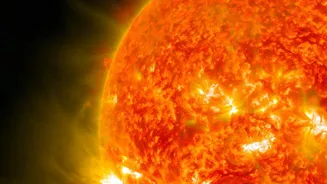
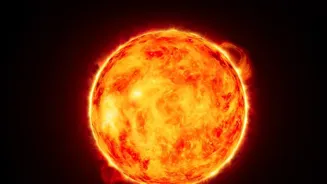
One of the longest-standing mysteries in solar physics is why the Sun's corona, its outer atmosphere, is millions of degrees hotter than its surface, which is a mere few thousand degrees. It defies the simple logic that things should get cooler the farther you move from a heat source. Scientists believe the answer lies in the complex magnetic field activity that drives phenomena like solar flares and CMEs. Observing the corona is notoriously difficult because the Sun's brilliant surface outshines it. Coronagraphs like VELC and ASPIICS are designed to solve this by blocking the main disk, but each has its own strengths.
Stronger Together: A Complementary View
The true power of this new research comes from combining the complementary capabilities of the two instruments. Aditya-L1's VELC provides spectroscopic data, giving scientists detailed information on the properties of the coronal plasma. Meanwhile, Proba-3's ASPIICS provides high-resolution images of the corona's structure. By pairing these two different types of observation of the same solar events, researchers can cross-check their findings and build a much more robust, three-dimensional understanding of how CMEs originate and evolve in their crucial first moments. The joint study successfully measured the mass, density, and energy of CMEs with unprecedented accuracy, providing vital new constraints for scientific models.