





The Case of the Missing Mass
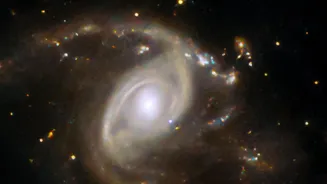
The story of dark matter begins with a simple observation that broke our understanding of the cosmos. In the 1970s, astronomer Vera Rubin was studying the speed of stars rotating around the center of galaxies. Logic dictates that stars farther from the dense,
bright galactic center should move more slowly, just as outer planets in our solar system orbit the sun more slowly than inner ones. But that’s not what she found. Instead, stars on the outskirts were moving just as fast as those closer in. This implied the galaxies were far more massive than they appeared. There had to be some extra, invisible mass providing the gravitational glue needed to keep these rapidly spinning galaxies from flying apart. This 'missing mass' is what we now call dark matter. Since then, other evidence has piled up, from the way light bends around galaxy clusters (gravitational lensing) to the large-scale structure of the universe itself. Scientists are certain it's out there; it's the architectural scaffolding of the cosmos.
Identifying the Usual Suspects
So, if dark matter is real, what could it be? It doesn't absorb, reflect, or emit light, so it can't be made of the same stuff as us—protons, neutrons, and electrons. This has led physicists to propose several exotic candidates. For decades, the leading contender was a class of hypothetical particles called WIMPs, or Weakly Interacting Massive Particles. As the name suggests, they would be heavy but would only interact with normal matter through gravity and the weak nuclear force, making them incredibly difficult to detect. Another prominent candidate is the axion, a particle predicted to be extraordinarily light and even more elusive than the WIMP. In the presence of a strong magnetic field, an axion could theoretically transform into a detectable particle of light, a photon. Other, more fringe theories propose everything from sterile neutrinos to primordial black holes formed in the very first moments of the universe as potential identities for dark matter.
The Worldwide Dragnet
How do you catch a ghost? With a very sensitive net. The hunt for dark matter is happening on three main fronts: direct detection, indirect detection, and creation. Direct detection experiments are built deep underground to shield them from cosmic rays and other background radiation that could mimic a dark matter signal. Experiments like LUX-ZEPLIN (LZ) and XENONnT use massive tanks filled with cooled, liquid noble gases like xenon. The hope is that a WIMP will occasionally bump into a xenon nucleus, creating a tiny flash of light that sensitive detectors can pick up. Indirect detection involves looking for the byproducts of dark matter, such as gamma rays that might be produced when two dark matter particles meet and annihilate each other. Finally, particle accelerators like the Large Hadron Collider are used to smash protons together at incredible speeds, with scientists hoping to create a dark matter particle in the resulting debris.
Why Is It So Hard to Find?
Despite a global effort spanning decades and involving some of the most sensitive instruments ever built, dark matter's identity remains unconfirmed. The primary reason for this is that it barely interacts with the world we can see and touch. Gravity, the only force through which we know it interacts, is incredibly weak compared to electromagnetism. The challenge is like trying to feel the gravitational pull of an apple from across the room while standing in a hurricane. Any potential signal is infinitesimally small and easily drowned out by background noise. While there have been tantalizing hints and mysterious signals, such as one recently reported by the LUX-ZEPLIN experiment in September 2026, none have yet reached the threshold of a conclusive discovery. Each null result, however, is still valuable, as it helps scientists rule out certain theories and narrow the search, forcing them to build even more sensitive detectors and explore new possibilities.