








The Mythological Battle in the Sky
The core reason for these observances lies in Hindu mythology, specifically the story of the Samudra Manthan, or the churning of the cosmic ocean. According to legend, the gods (Devas) and demons (Asuras) churned the ocean to obtain Amrita, the nectar
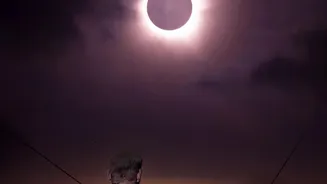
of immortality. When the nectar emerged, Lord Vishnu took the form of a beautiful woman, Mohini, to trick the demons and ensure only the gods received it. However, one sharp-witted Asura, Svarbhanu, disguised himself as a god and sat between the Sun God (Surya) and the Moon God (Chandra) to get a drop of the nectar. Just as he consumed it, Surya and Chandra exposed his deceit. Instantly, Vishnu severed Svarbhanu's head with his Sudarshana Chakra. Because the nectar had made him immortal, the head (Rahu) and the body (Ketu) survived as two separate entities in the cosmos. Filled with eternal vengeance against the Sun and Moon for revealing him, Rahu is said to periodically swallow them, causing an eclipse. Since Rahu has no body, the Sun or Moon eventually re-emerges, explaining the temporary nature of the event.
The Concept of an Inauspicious Time
Due to this mythological origin, eclipses (Grahan) are generally considered inauspicious or a time of cosmic imbalance. It is believed that during this period, negative energies are heightened. This leads to the observance of a 'Sutak' period, a window of time deemed ritually impure, which begins hours before the eclipse and ends after it is over. For a solar eclipse, the Sutak period typically starts 12 hours prior, while for a lunar eclipse, it is 9 hours. This rule, however, generally only applies to regions where the eclipse is visible. During Sutak, the atmosphere is believed to be contaminated, and devotees take precautions to avoid harmful side effects. Many temples close their doors, and touching idols is forbidden until purification rituals are performed after the eclipse.
Rituals of Caution and Cleansing
The belief in negative energies dictates a set of practices and prohibitions. Many people fast during the eclipse, refraining from cooking, eating, or even drinking water. It is thought that food prepared or consumed during this time can become energetically impure. To protect stored food and water from these energies, blades of Kusha grass or Tulsi (holy basil) leaves are often placed on them. Special care is advised for pregnant women, who are traditionally told to stay indoors and avoid using sharp objects like knives, based on the belief that it could affect the baby. After the eclipse concludes, a cleansing ritual is common. This usually involves taking a bath, changing into fresh clothes, and sprinkling holy water (Gangajal) around the house to purify the environment. Giving charity after an eclipse is also considered highly beneficial.
A Time for Spiritual Focus
While the period is seen as inauspicious for worldly activities, it is considered highly potent for spiritual practices. Many use the time not for fear, but for introspection, meditation, and prayer. Chanting mantras is a central activity, as it is believed that the spiritual benefits of such practices are multiplied manifold during an eclipse. Mantras like the Gayatri Mantra or Mahamrityunjaya Mantra are commonly recited to ward off evil and foster positive energy. For spiritual seekers, the eclipse offers a unique window to withdraw from daily distractions and turn inward, using the cosmic event as a powerful moment for devotion and reflection.
Tradition in the Modern Age
In contemporary India, the observance of these traditions varies. In many households, especially among older generations and in rural areas, the rituals are followed diligently. In urban centres, the approach is more mixed. Some may follow the customs out of respect for family tradition, while others view them as symbolic gestures. Even as science provides a clear astronomical explanation for eclipses, these ancient beliefs and practices continue to coexist. They serve as a powerful link to cultural identity, mythology, and a spiritual worldview that sees the cosmos not just as a physical space, but as a deeply interconnected, living entity.